
The words sell and sale are closely related, but they have different meanings and grammatical roles. Both are connected to buying and selling products or services, which is why students, English learners, and even native speakers sometimes confuse them. However, knowing when to use each word can make your writing and everyday conversations clearer.
The main difference between sell vs. sale is that sell is a verb, while sale is a noun. You use sell when talking about the action of exchanging something for money. You use sale when referring to the act of selling, a special offer, or an event where products are available at reduced prices.
For example, “I want to sell my car” describes an action, while “My car is for sale” means someone can buy it. Understanding this simple distinction will help you choose the correct word in sentences, advertisements, business conversations, and everyday English.
Quick Answer: Sell vs. Sale
Sell is a verb that means to give something to someone in exchange for money. Sale is a noun that refers to the process of selling something or an event where products are offered at reduced prices. For example, “They sell shoes” describes an action, while “The shoes are on sale” describes a special offer.
Why Do People Confuse Sell and Sale?
People confuse sell and sale because both words relate to the same activity: exchanging goods or services for money. They also have similar spellings and pronunciations, making them easy to mix up.
However, their grammatical functions are different. Sell describes what someone does, whereas sale names an event, transaction, or selling opportunity.
Consider these examples:
- I want to sell my old phone.
- My old phone is for sale.
- This store sells furniture.
- The store is having a furniture sale.
The easiest way to avoid confusion is to remember that sell is an action word (verb), while sale is a naming word (noun).
What Does Sell Mean?
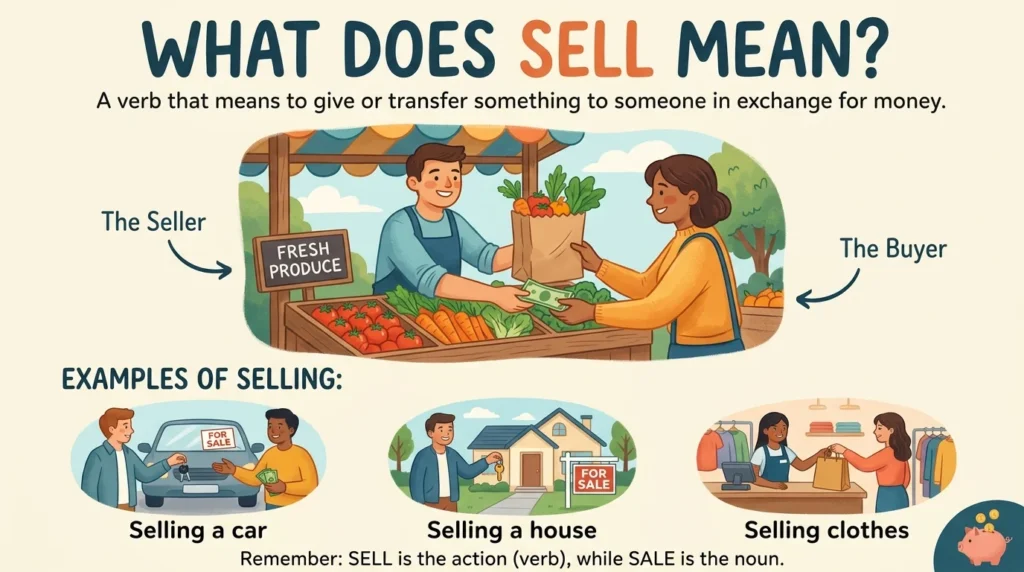
Sell is a verb that means to exchange something for money or offer goods and services to customers in return for payment.
It describes the action performed by a person, business, or organization that provides something to a buyer.
Examples:
- I want to sell my old bicycle.
- They sell fresh vegetables at the market.
- She plans to sell her house next year.
- This company sells electronic products online.
- He knows how to sell his ideas effectively.
Different Forms of Sell
The verb sell has several forms that you may encounter in English:
| Verb Form | Word | Example |
| Base form | Sell | I sell clothes online. |
| Third-person singular | Sells | She sells handmade bags. |
| Past tense | Sold | He sold his laptop. |
| Past participle | Sold | They have sold their house. |
| Present participle | Selling | We are selling our products. |
Important: The past tense and past participle of sell are sold, not saled.
What Does Sale Mean?

Sale is a noun that refers to the act of selling something, a business transaction, or an event in which products are offered at reduced prices.
It is commonly used in shopping, advertising, retail, and business conversations.
Examples:
- The store is having a winter sale.
- Our house is for sale.
- The company reported an increase in sales.
- I bought this jacket during the summer sale.
- The final sale cannot be refunded.
Common Expressions with Sale
- For sale: Something is available for purchase.
- On sale: Something is being offered at a reduced price in many shopping contexts.
- Sale price: The reduced price of a product.
- Sales tax: A tax charged on certain purchases.
- Garage sale: An event where people sell used household items.
- Clearance sale: An event where products are sold at reduced prices to clear inventory.
Sell vs. Sale: What’s the Difference?
Although sell and sale are related, they serve different purposes in English. The following table explains their key differences.
| Feature | Sell | Sale |
| Part of speech | Verb | Noun |
| Meaning | To exchange something for money | The act or event of selling |
| Usage | Describes an action | Names an event or transaction |
| Example | I sell shoes. | The shoes are on sale. |
| Past form | Sold | Not applicable |
| Common phrase | Sell products | For sale |
| Related word | Seller | Sales |
Simple distinction: Use sell when someone performs the action of selling. Use sale when referring to the selling event, transaction, or offer.
When Should You Use Sell or Sale?
Choosing between sell and sale becomes easier when you understand the purpose of your sentence.
When to Use Sell
Use sell when you want to describe the action of exchanging goods, property, or services for money.
Common situations include:
- Selling products: They sell clothes online.
- Selling property: We want to sell our house.
- Running a business: My parents sell furniture.
- Offering services: The company sells insurance.
- Describing past actions: She sold her old car yesterday.
Remember that sell changes according to the tense of the sentence.
When to Use Sale
Use sale when you are talking about a selling event, a transaction, or a special shopping offer.
Common situations include:
- Shopping discounts: The store has a summer sale.
- Available products: This laptop is for sale.
- Business transactions: The sale was completed yesterday.
- Special offers: Everything is on sale this weekend.
- Property listings: Their house is up for sale.
Remember that sale is a noun, so it does not function as the main action verb in a sentence.
12 Examples of Sell vs. Sale in Sentences
Here are practical examples that show how to use sell and sale correctly in everyday English.
Examples Using Sell
- I want to sell my old car because I need a new one.
- They sell fresh fruit at the local market.
- My brother plans to sell his gaming computer.
- This company sells high-quality shoes.
- She sold her house last month.
- We are selling handmade products online.
Examples Using Sale
- The store is having a big sale this weekend.
- My old bicycle is for sale.
- I bought these shoes during the winter sale.
- The company announced the sale of its new product line.
- Many customers visited the store during the clearance sale.
- This television is currently on sale for $300.
Common Mistakes When Using Sell and Sale
Even though these words have straightforward meanings, people sometimes use them incorrectly. Here are some common mistakes and their corrections.
| Incorrect | Correct | Explanation |
| I want to sale my car. | I want to sell my car. | Use the verb sell for an action. |
| My house is for sell. | My house is for sale. | Use the noun sale in this expression. |
| The shop sale clothes. | The shop sells clothes. | Use sells with a singular subject. |
| The products are sell. | The products are for sale. | Use the correct noun expression. |
| She saled her phone. | She sold her phone. | The past tense of sell is sold. |
| Everything is for sell. | Everything is for sale. | The standard expression is for sale. |
A useful tip: If you are describing an action, choose sell. If you are talking about an item being available to buy or a shopping event, choose sale.
Memory Trick: How to Remember Sell vs. Sale
A simple memory trick can help you remember the difference between these two words.
- Sell = Something you do. Think of the action of selling a product.
- Sale = Something you have. Think of a shopping event, business transaction, or special offer.
You can also remember these two common expressions:
- Sell a car: You perform the action of selling it.
- A car for sale: The car is available for someone to buy.
Quick memory tip: If you can replace the word with an action like trade or exchange, you probably need sell. If you are naming an event or opportunity, you probably need sale.
Sell vs. Sale in American and British English
There is no significant spelling or meaning difference between sell and sale in American and British English. Both varieties use these words in the same grammatical way.
| Usage | American English | British English |
| Verb | Sell | Sell |
| Noun | Sale | Sale |
| Past tense | Sold | Sold |
| Available for purchase | For sale | For sale |
| Discounted products | On sale | On sale |
Examples:
- American English: I want to sell my old car.
- British English: I want to sell my old car.
- American English: These shoes are on sale.
- British English: These shoes are on sale.
The spelling and basic usage remain the same in both varieties.
Similar Words Related to Sell and Sale
Understanding related vocabulary can help you expand your English vocabulary and use these words more accurately.
| Word | Meaning | Example |
| Seller | A person or business that sells something | The seller offered a discount. |
| Buyer | A person who purchases something | The buyer paid in cash. |
| Purchase | To buy something | I want to purchase a new phone. |
| Trade | To exchange something | They traded their old car. |
| Retail | Selling goods directly to customers | She works in retail. |
| Wholesale | Selling goods in large quantities, usually to businesses | They sell wholesale products. |
| Salesperson | Someone whose job is selling products | The salesperson helped me. |
| Discount | A reduction in the original price | I received a 20% discount. |
| Sold | The past tense of sell | He sold his bicycle. |
| Bargain | Something bought at a good price | This jacket was a bargain. |
Final Verdict: Sell or Sale?
The correct choice depends on what you want to express. Sell is a verb that describes the action of exchanging something for money, while sale is a noun that refers to a selling event, transaction, or special offer.
Use sell in sentences such as “I want to sell my car.” Use sale in expressions such as “My car is for sale” or “The store is having a summer sale.” Remembering their different grammatical roles will help you avoid common spelling and vocabulary mistakes.
Frequently Asked Questions (FAQs)
1. What is the main difference between sell and sale?
The main difference is their grammatical function. Sell is a verb that describes the action of exchanging something for money, while sale is a noun that refers to a selling event, transaction, or special offer.
2. Is it for sell or for sale?
The correct expression is for sale, not for sell. Use it when something is available for someone to purchase.
Example: My old laptop is for sale.
3. Is it on sell or on sale?
The correct expression is on sale, not on sell. It commonly means that a product is available at a reduced price.
Example: These shoes are on sale today.
4. Is sale a verb or a noun?
Sale is a noun. It refers to the act of selling, a completed transaction, or an event where products are offered at discounted prices.
Example: The store announced a summer sale.
5. What is the past tense of sell?
The past tense of sell is sold. The past participle is also sold.
Example: She sold her old phone yesterday.
6. Can I use sale and sell in the same sentence?
Yes. You can use both words in the same sentence because they have different grammatical functions.
Example: The store will sell more products during its annual sale.
7. What is the difference between on sale and for sale?
On sale commonly means that something is being offered at a reduced price. For sale means that something is available to purchase, whether or not it has a discount.
Examples:
- This shirt is on sale for $15.
- This house is for sale.
Remember This
- Sell = Verb: The action of exchanging something for money.
- Sale = Noun: A selling event, transaction, or special offer.
- Sold = Past tense: The correct past form of sell.
- For sale = Available to buy.
- On sale = Usually available at a reduced price.
Conclusion
Understanding the difference between sell vs. sale is simple once you recognize their grammatical roles. Sell describes the action of exchanging products or services for money, whereas sale refers to the selling process, a transaction, or a special shopping offer. Although the words are closely related, they cannot be used interchangeably.
To use them correctly, remember common expressions such as sell a product, for sale, and on sale. Practice these words in everyday sentences, and you will find it easier to avoid common mistakes in speaking and writing.

Hello, I’m Isabella Collins, a language enthusiast passionate about helping readers discover accurate synonyms and enrich their vocabulary. I create clear, practical content that makes English writing easier, stronger, and more expressive.