
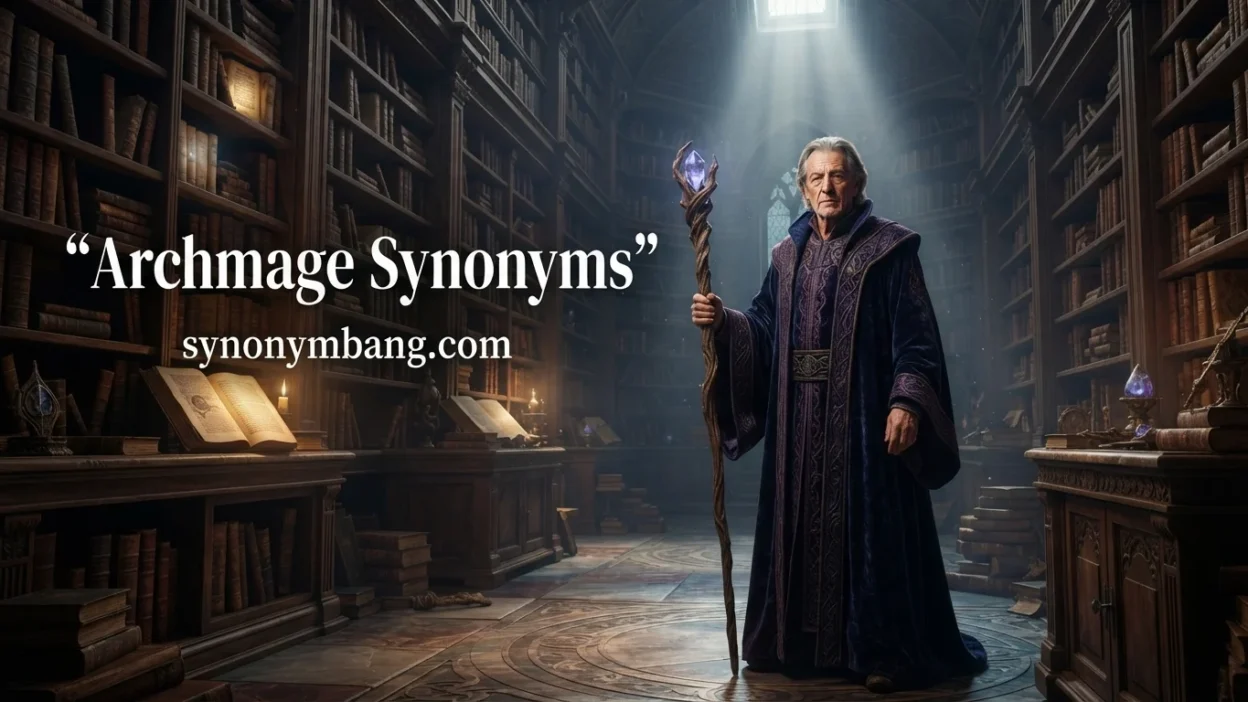
Finding the right archmage synonyms can be useful when writing fantasy stories, role-playing games, magical fiction, or descriptions of powerful spellcasters. The word “archmage” has a very specific meaning, so many alternatives are related terms rather than exact dictionary synonyms. Choosing the right expression can help you describe a magical character more accurately and naturally.
An archmage is usually a highly skilled and powerful magic user, especially a wizard or mage who has reached an advanced level of magical knowledge and ability. The word is strongly associated with fantasy literature, games, mythology-inspired worlds, and fictional magical systems.
Because “archmage” is a specialized fantasy term, its alternatives can differ in tone. Some suggest great magical power, while others emphasize wisdom, experience, authority, or mastery. Understanding these differences helps writers choose vocabulary that fits their fictional world.
What Does Archmage Mean?
An archmage is an extremely powerful or highly accomplished mage, wizard, or magic-user. In many fantasy settings, an archmage is considered one of the highest-ranking practitioners of magic.
In simple English, an archmage is a very powerful and experienced magician or wizard.
The word has a fantasy, epic, mysterious, and authoritative tone. It is rarely used in ordinary everyday English. You are most likely to see it in fantasy novels, video games, tabletop role-playing games, fictional histories, and magical world-building.
For example:
The ancient archmage protected the kingdom with powerful spells.
Here, “archmage” suggests more than someone who simply knows magic. It implies exceptional skill, knowledge, experience, or status.
30 Archmage Synonyms and Related Words
Since “archmage” is a specialized fantasy title, the following words include close synonyms, related terms, descriptive alternatives, and titles that can work in different fictional contexts.
1. Mage
Meaning: A person who practices magic.
Example: The mage studied ancient spells in the royal library.
Best usage context: General fantasy writing.
2. Wizard
Meaning: A person who uses magic, often with advanced knowledge and skill.
Example: The old wizard guarded the secrets of the enchanted forest.
Best usage context: Traditional fantasy stories.
3. Sorcerer
Meaning: A person who practices powerful or mysterious magic.
Example: The sorcerer summoned a wall of fire.
Best usage context: Dark, dramatic, or powerful magical characters.
4. Sorceress
Meaning: A female practitioner of powerful magic.
Example: The ancient sorceress ruled the magical kingdom for centuries.
Best usage context: Female magical characters.
5. Magician
Meaning: A person who performs magic or uses supernatural powers in a fictional setting.
Example: The magician used an ancient spell to open the sealed gate.
Best usage context: General writing, although it can also mean a stage performer in real-world contexts.
6. Spellcaster
Meaning: Someone who casts magical spells.
Example: The powerful spellcaster defeated the invading army.
Best usage context: Fantasy games and modern fantasy fiction.
7. Enchanter
Meaning: A person who uses magic to enchant objects, people, or places.
Example: The enchanter placed a protective spell on the sword.
Best usage context: Magical crafting and enchantment-based fantasy.
8. Enchantress
Meaning: A female enchanter or magical woman who uses enchantment.
Example: The enchantress placed a powerful charm on the crown.
Best usage context: Fantasy stories involving charms or magical influence.
9. Magus
Meaning: A learned or powerful magician, especially in fantasy or historical-style writing.
Example: The ancient magus possessed knowledge that had been forgotten by other wizards.
Best usage context: Formal, ancient, or epic fantasy.
10. High Mage
Meaning: A mage with a very high rank or level of magical ability.
Example: Only the High Mage could enter the sacred tower.
Best usage context: Fantasy hierarchies and magical institutions.
11. High Wizard
Meaning: A wizard who holds a superior rank or possesses exceptional magical power.
Example: The High Wizard advised the king during the magical war.
Best usage context: Fantasy kingdoms and magical councils.
12. Master Mage
Meaning: A mage who has achieved an advanced level of knowledge and skill.
Example: The Master Mage taught young apprentices the secrets of elemental magic.
Best usage context: Training, academies, and fantasy guilds.
13. Master Wizard
Meaning: A highly experienced and skilled wizard.
Example: The Master Wizard could control several spells at once.
Best usage context: Fantasy stories emphasizing expertise.
14. Grand Mage
Meaning: A highly respected or powerful mage.
Example: The Grand Mage summoned the council to discuss the coming threat.
Best usage context: Magical leadership and fantasy governments.
15. Grand Wizard
Meaning: A wizard with exceptional power or authority.
Example: The Grand Wizard protected the ancient magical order.
Best usage context: Fantasy organizations and fictional titles.
16. Supreme Mage
Meaning: A mage portrayed as having extremely high magical power or rank.
Example: The Supreme Mage was believed to command the strongest elemental forces.
Best usage context: Epic fantasy and fictional hierarchies.
17. Master Sorcerer
Meaning: A sorcerer with exceptional magical knowledge and ability.
Example: The Master Sorcerer defeated the demon with a single spell.
Best usage context: Powerful fantasy characters.
18. Magical Master
Meaning: A person who has mastered magical arts.
Example: After decades of study, she became a true magical master.
Best usage context: Descriptive fantasy writing.
19. Arcane Master
Meaning: Someone who has mastered arcane or mysterious magical knowledge.
Example: The Arcane Master deciphered the forgotten magical language.
Best usage context: Advanced magical lore.
20. Arcane Sage
Meaning: A wise person with deep knowledge of magical or mysterious subjects.
Example: The Arcane Sage warned the heroes about the forbidden spell.
Best usage context: Wise and scholarly magical characters.
21. Magic Sage
Meaning: A very wise and experienced practitioner of magic.
Example: The magic sage had spent his life studying ancient spells.
Best usage context: Wisdom-focused fantasy characters.
22. Mystic
Meaning: A person connected with mysterious or supernatural knowledge.
Example: The mystic predicted that the enchanted kingdom was in danger.
Best usage context: Mysterious, spiritual, or supernatural fantasy.
23. Thaumaturge
Meaning: A person who performs extraordinary or miraculous magical acts.
Example: The legendary thaumaturge could transform ordinary stones into gold.
Best usage context: Formal, scholarly, or high-fantasy writing.
24. Adept
Meaning: A person who is highly skilled at a particular activity or magical art.
Example: The young adept quickly mastered the difficult spell.
Best usage context: Skill-focused fantasy writing.
25. Magister
Meaning: A learned master or authority, sometimes used as a magical title in fantasy settings.
Example: The Magister supervised the kingdom’s most powerful spellcasters.
Best usage context: Formal fantasy titles and magical institutions.
26. Arcane Scholar
Meaning: A scholar who studies magic and hidden knowledge.
Example: The arcane scholar discovered a spell hidden in an ancient manuscript.
Best usage context: Intellectual and academic fantasy characters.
27. Master of Magic
Meaning: A person recognized as a master of magical arts.
Example: The Master of Magic was summoned to defend the capital.
Best usage context: Formal titles and epic fantasy.
28. Magical Elder
Meaning: An older and highly experienced magical practitioner.
Example: The magical elder shared ancient wisdom with the young heroes.
Best usage context: Wise, experienced fantasy characters.
29. Spell Master
Meaning: Someone exceptionally skilled at using magical spells.
Example: The spell master could weave several complex spells together.
Best usage context: Game-inspired and action-focused fantasy.
30. Grand Sorcerer
Meaning: A very powerful or highly ranked sorcerer.
Example: The Grand Sorcerer commanded the magical forces of the kingdom.
Best usage context: Epic fantasy, magical leadership, and fictional titles.
Archmage Synonyms Comparison Table
| Word or Phrase | Main Meaning | Tone | Best Use |
| Mage | Magic user | Neutral | General fantasy |
| Wizard | Skilled magic user | Traditional | Fantasy fiction |
| Sorcerer | Powerful magic user | Dramatic | Epic or dark fantasy |
| Magus | Learned magician | Ancient | High fantasy |
| Spellcaster | Person who casts spells | Modern | Games and fantasy |
| Enchanter | Magic user focused on enchantment | Mystical | Magical objects |
| High Mage | High-ranking mage | Authoritative | Fantasy hierarchy |
| Master Mage | Highly skilled mage | Respectful | Magical academies |
| Grand Mage | Powerful and respected mage | Epic | Fantasy leadership |
| Arcane Sage | Wise magical scholar | Scholarly | Lore-heavy fantasy |
| Mystic | Mysterious supernatural figure | Mysterious | Mystical fiction |
| Thaumaturge | Performer of extraordinary magic | Formal | High fantasy |
| Adept | Highly skilled practitioner | Technical | Training and progression |
| Magister | Magical authority or master | Formal | Fantasy institutions |
| Grand Sorcerer | Extremely powerful sorcerer | Epic | Fantasy leadership |
How to Choose the Right Archmage Synonym
The best alternative depends on the character’s power, experience, personality, role, and position within your fictional world.
For General Fantasy Characters
Choose mage, wizard, or spellcaster when you simply need a word for someone who uses magic.
These terms are familiar and easy for most readers to understand.
For Powerful Characters
Use sorcerer, master sorcerer, grand sorcerer, or supreme mage when you want to emphasize magical strength.
These words create a stronger sense of power and importance.
For Wise Characters
Choose arcane sage, magic sage, mystic, or magical elder when wisdom and experience are more important than raw magical strength.
These expressions work particularly well for mentors and ancient characters.
For Scholarly Characters
Use arcane scholar, magus, or magister when the character is associated with books, magical research, ancient knowledge, or formal study.
These terms give the character a more intellectual quality.
For Fantasy Leadership
High Mage, High Wizard, Grand Mage, Master of Magic, and Grand Sorcerer can work well as titles for characters who lead magical organizations.
They suggest authority as well as magical ability.
For Enchantment-Based Magic
If the character specializes in magical objects, charms, or enchantments, enchanter or enchantress may be more precise.
For example, a character who spends most of their time placing magical properties on weapons could be described as an enchanter rather than simply a mage.
Archmage vs. Mage
An archmage is generally portrayed as being far more advanced than an ordinary mage.
“Mage” is a broad term for someone who practices magic. “Archmage” usually suggests exceptional experience, power, knowledge, or status.
For example:
The young mage was still learning basic spells.
Compared with:
The ancient archmage had mastered thousands of spells.
The second sentence communicates a much higher level of magical achievement.
Archmage vs. Wizard
“Wizard” is a broad fantasy term for a magic user, while “archmage” usually functions as a title or description of an exceptionally accomplished magic user.
A fantasy world could have many wizards but only a few archmages.
The exact distinction depends on the fictional world’s rules.
Archmage vs. Sorcerer
The difference between archmage and sorcerer depends on the fantasy setting.
An archmage usually emphasizes rank, mastery, or magical expertise, while sorcerer often emphasizes the character’s magical abilities or type of magic.
A sorcerer can therefore be powerful without necessarily being an archmage.
Archmage vs. Magus
Both words can describe highly knowledgeable magical figures, but magus often has an ancient, scholarly, or formal feeling.
“Archmage” is more immediately recognizable as a fantasy title, while “magus” can give your writing an older or more historical atmosphere.
Why Are Archmage Synonyms Often Different From Exact Synonyms?
“Archmage” is not an ordinary everyday noun. It is a specialized fantasy term that often combines several ideas:
- Magical ability
- Experience
- Knowledge
- Authority
- Status
- Mastery
Because of this, no single alternative will always carry exactly the same meaning.
For example, wizard emphasizes the magical character, while magister may emphasize authority and arcane sage emphasizes wisdom and knowledge.
This is why context matters when selecting an alternative.
Examples of Archmage Synonyms in Sentences
Here are some natural examples:
- The mage studied elemental magic for many years.
- The ancient wizard protected the village from dark forces.
- The sorcerer unleashed a powerful magical attack.
- The magus translated the forgotten spell.
- The High Mage advised the royal council.
- The arcane sage knew the secrets of the lost civilization.
- The Master Mage trained a new generation of spellcasters.
- The enchanter created a magical sword.
- The thaumaturge performed an extraordinary magical ritual.
- The Grand Sorcerer commanded the kingdom’s magical forces.
Tips for Using Archmage Synonyms in Fantasy Writing
Avoid replacing “archmage” with another term simply to prevent repetition. Instead, choose a word that adds useful information about the character.
If you want to emphasize power, use terms such as “grand sorcerer” or “supreme mage.”
If you want to emphasize wisdom, “arcane sage” or “magical elder” may work better.
If you want to emphasize authority, “High Mage,” “Magister,” or “Master of Magic” can be effective.
If you want to emphasize magical specialization, terms such as “enchanter” or “spell master” may provide more detail.
This approach makes your writing more precise rather than simply replacing one word with another.
FAQs: About Archmage Synonyms
What is another word for archmage?
Common alternatives include high mage, grand mage, master mage, master wizard, magus, arcane sage, and grand sorcerer. The best choice depends on the fictional setting.
What is the closest synonym for archmage?
There is no perfect synonym in every context. High Mage, Master Mage, and Grand Mage are close descriptive alternatives because they can communicate advanced magical skill and status.
Is wizard the same as archmage?
Not necessarily. A wizard is generally a magic user, while an archmage usually represents a much higher level of magical expertise, authority, or status.
What is a female archmage called?
There is no universal feminine form required for “archmage.” A female character can simply be called an archmage. Depending on the setting, terms such as “sorceress” or “enchantress” may also be appropriate.
What does archmage mean in fantasy?
In fantasy, an archmage is usually an exceptionally powerful, knowledgeable, or high-ranking practitioner of magic.
What is a synonym for a powerful wizard?
Depending on the context, you could use archmage, master wizard, high wizard, grand mage, magus, or grand sorcerer.
Is magus a synonym for archmage?
“Magus” can be a close alternative in some fantasy settings, especially when the character is portrayed as a learned or powerful magician. However, the exact meanings can differ.
Conclusion
The best archmage synonyms depend on what you want your reader to notice about the character. Mage, wizard, sorcerer, magus, spellcaster, High Mage, Master Mage, Grand Mage, Arcane Sage, and Grand Sorcerer can all work in suitable contexts.
Remember that these terms are not always exact replacements. Some emphasize magical power, while others focus on wisdom, knowledge, authority, specialization, or fantasy-world status. Choosing the word that matches your character’s role will make your writing clearer and more vivid.
if you are writing a fantasy novel, designing a role-playing game, creating a magical world, or simply expanding your vocabulary, understanding these related terms can help you describe powerful magic users with greater precision.

I’m Grace Walker, the Administrator at SynonymBang. I manage daily operations, ensure content quality, support our editorial team, and strive to provide reliable synonym resources that help readers communicate with confidence.