
When writing or speaking English, choosing the correct past tense of a verb can sometimes be confusing. One common example is sweeped vs. swept. Both words may look like possible past-tense forms of the verb sweep, but only one is standard in modern English.
The correct past tense and past participle of sweep is swept, not sweeped. The word sweep is an irregular verb, which means it does not form its past tense by simply adding -ed. For example, you should write, “She swept the kitchen floor,” rather than “She sweeped the kitchen floor.” Understanding this spelling rule will help you avoid common grammar mistakes in everyday conversations, school assignments, emails, and professional writing.
Quick Answer: Sweeped or Swept?
Swept is the correct past tense and past participle of the verb sweep. Sweeped is a nonstandard form and should generally be avoided in modern English. Use swept when describing an action that happened in the past or when forming perfect tenses, such as “He swept the floor” and “She has swept the room.”
Why Do People Confuse Sweeped and Swept?
People confuse sweeped and swept because many English verbs form their past tense by adding -ed.
For example:
- Walk → Walked
- Clean → Cleaned
- Jump → Jumped
- Open → Opened
Following this familiar pattern, some people assume that sweep becomes sweeped. However, English also contains irregular verbs that change their spelling instead of following the regular -ed rule.
The verb sweep belongs to this group. Its forms are:
- Present: Sweep
- Past: Swept
- Past participle: Swept
- Present participle: Sweeping
This irregular pattern explains why swept is correct and sweeped is not the standard form.
What Does Swept Mean?
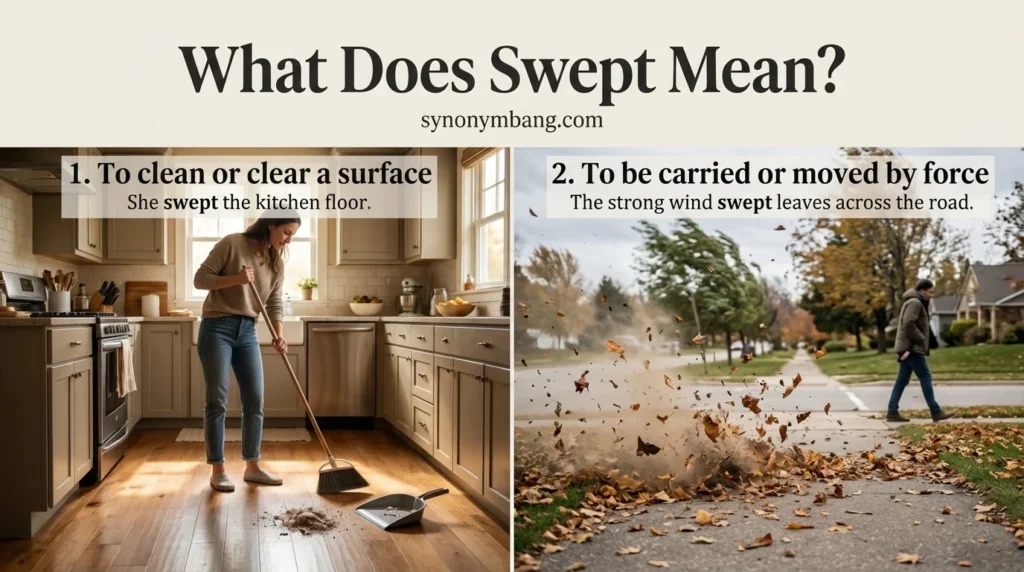
Swept is the simple past tense and past participle of the verb sweep. It means to clean or clear a surface using a broom or brush. It can also describe moving something quickly, spreading across an area, or carrying something away with force.
The word has several meanings depending on the context.
1. To Clean with a Broom
This is the most common meaning of swept. It describes removing dust, dirt, or rubbish from a floor or surface.
Examples:
- She swept the kitchen floor this morning.
- He swept the leaves from the garden.
- They swept the classroom before leaving.
2. To Move or Carry Something Away
Swept can describe something being moved by wind, water, or another powerful force.
Examples:
- The strong wind swept the leaves away.
- The river swept the branches downstream.
- The storm swept across the coastline.
3. To Spread Quickly
The word can also describe something spreading rapidly through a place or group.
Examples:
- Excitement swept through the crowd.
- A wave of sadness swept over her.
- The news swept across the country.
4. To Win Completely
In sports and competitions, swept can describe winning every game or match in a series.
Example:
- The team swept the championship series.
What Does Sweeped Mean?
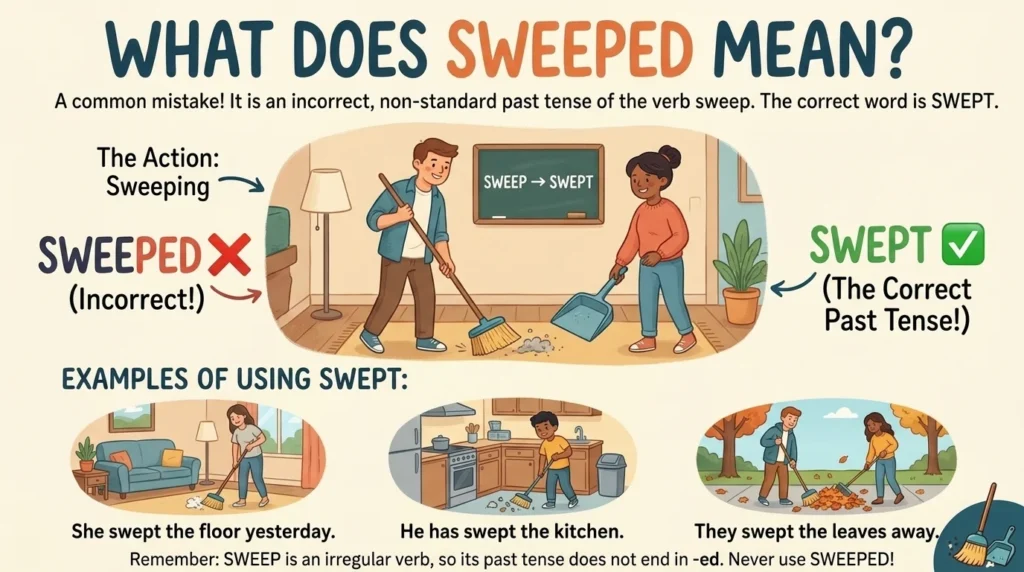
Sweeped is a nonstandard past-tense form of sweep. Some English learners and speakers use it because they assume the verb follows the regular pattern of adding -ed.
However, standard modern English uses swept instead.
Incorrect: She sweeped the living room yesterday.
Correct: She swept the living room yesterday.
Although you may occasionally encounter sweeped in informal writing, spelling mistakes, or learner English, it is not the accepted standard form for ordinary writing and communication.
Sweeped vs. Swept: Key Differences
| Feature | Sweeped | Swept |
| Grammatical status | Nonstandard form | Correct standard form |
| Verb | Sweep | Sweep |
| Past tense | Incorrect | Swept |
| Past participle | Incorrect | Swept |
| Present tense | Not applicable | Sweep |
| Present participle | Not applicable | Sweeping |
| Formal writing | Avoid | Correct |
| Example | She sweeped the floor. | She swept the floor. |
The main difference is simple: swept is the correct irregular past-tense form, while sweeped is a nonstandard spelling.
When Should You Use Swept or Sweeped?
Knowing when to use these forms makes your writing clearer and grammatically correct.
When to Use Swept
Use swept when describing an action that happened in the past.
Examples:
- I swept the garage yesterday.
- She swept the floor after dinner.
- They swept the garden clean.
Use swept as a past participle with helping verbs such as has, have, and had.
Examples:
- He has swept the entire house.
- We have swept the classroom.
- She had swept the floor before the guests arrived.
You can also use swept in passive constructions.
Example:
- The leaves were swept away by the wind.
When to Use Sweeped
In standard modern English, you should not use sweeped as the past tense or past participle of sweep.
Instead, use swept in every ordinary grammatical context.
Incorrect: The workers have sweeped the street.
Correct: The workers have swept the street.
15 Examples of Swept in Sentences
Here are 15 practical examples to help you understand how to use swept correctly.
- She swept the kitchen floor before cooking dinner.
- I swept the dust out of the room yesterday.
- The children swept the classroom after the lesson.
- He swept the fallen leaves from the driveway.
- My mother swept the hallway early this morning.
- The strong wind swept the papers off the table.
- The river swept away several wooden branches.
- Excitement swept through the audience.
- A sudden feeling of happiness swept over him.
- The cleaning staff swept the entire building.
- She has swept the living room twice today.
- We had swept the garden before the rain started.
- The storm swept across the coastal region.
- The team swept the series and won every match.
- The workers swept the broken glass into a pile.
These examples show that swept works in different situations, including cleaning, movement, emotions, weather, and sports.
Common Mistakes to Avoid
English learners sometimes make mistakes when using irregular verbs. Here are some common errors involving sweep.
Mistake 1: Adding -ed to Sweep
Incorrect: He sweeped the floor.
Correct: He swept the floor.
Mistake 2: Using Sweeped with Has or Have
Incorrect: She has sweeped the room.
Correct: She has swept the room.
Mistake 3: Using Sweeped in a Past-Tense Sentence
Incorrect: They sweeped the classroom yesterday.
Correct: They swept the classroom yesterday.
Mistake 4: Confusing Swept with Sweeping
Incorrect: She was swept the floor.
Correct: She was sweeping the floor.
Remember that sweeping describes an ongoing action, while swept describes a completed action or serves as a past participle.
Memory Trick: How to Remember Swept
A simple way to remember the correct spelling is to memorize this pattern:
Sweep → Swept → Swept
Think of other irregular verbs that change their spelling in the past tense:
- Keep → Kept
- Sleep → Slept
- Sweep → Swept
Notice that these verbs follow a similar spelling pattern. Instead of adding -ed, they change their endings.
Whenever you need the past tense of sweep, remember that it follows the same pattern as keep and sleep.
American vs. British English: Is Swept Different?
There is no spelling difference between American and British English when using the past tense of sweep.
Both varieties use swept as the standard past tense and past participle.
| English Variety | Correct Form | Example |
| American English | Swept | She swept the floor. |
| British English | Swept | She swept the floor. |
Whether you are writing for an American or British audience, use swept, not sweeped.
Similar Words: Other Irregular Verbs Like Swept
If you find sweeped vs. swept confusing, learning similar irregular verbs can help you improve your English grammar.
| Present Tense | Past Tense | Past Participle |
| Sweep | Swept | Swept |
| Keep | Kept | Kept |
| Sleep | Slept | Slept |
| Weep | Wept | Wept |
| Creep | Crept | Crept |
| Feel | Felt | Felt |
| Leave | Left | Left |
| Build | Built | Built |
| Send | Sent | Sent |
| Spend | Spent | Spent |
These verbs do not follow the regular -ed pattern. Memorizing their forms will help you avoid similar mistakes.
Final Verdict: Sweeped or Swept?
The correct word is swept, not sweeped. Swept is the simple past tense and past participle of the irregular verb sweep.
Use swept when describing cleaning with a broom, something moving with force, or an event spreading across an area. Avoid sweeped in standard English because it is a nonstandard verb form.
Frequently Asked Questions (FAQs)
1. Is It Sweeped or Swept?
Swept is correct. It is the simple past tense and past participle of the irregular verb sweep. Sweeped is a nonstandard form and should be avoided in standard English.
2. Is Sweeped a Real Word?
Sweeped may appear in informal writing or as a learner’s spelling error, but it is not the accepted standard past-tense form of sweep. The correct word is swept.
3. What Is the Past Tense of Sweep?
The past tense of sweep is swept.
Example: She swept the floor yesterday.
4. What Is the Past Participle of Sweep?
The past participle of sweep is also swept.
Example: He has swept the entire house.
5. Is It Swept or Sweepen?
Swept is correct. Sweepen is not a standard English form of the verb sweep.
6. What Are the Three Forms of Sweep?
The three main forms of the verb sweep are:
- Present: Sweep
- Past: Swept
- Past participle: Swept
The present participle is sweeping.
7. Can I Say “I Have Sweeped the Floor”?
No. This sentence is grammatically incorrect in standard English. The correct sentence is “I have swept the floor.” Always use swept with helping verbs such as has, have, and had.
Remember This
- Swept is the correct past tense of sweep.
- Swept is also the correct past participle.
- Sweeped is a nonstandard form.
- Both American and British English use swept.
- Remember the pattern: Sweep → Swept → Swept.
Conclusion
Understanding the difference between sweeped vs. swept is easy once you remember that sweep is an irregular verb. Unlike regular verbs that form their past tense by adding -ed, sweep changes to swept. This is why “She swept the floor” is correct, while “She sweeped the floor” is not standard English.
if you describe cleaning a surface, moving something with force, or something spreading quickly in the past, choose swept. Practice the pattern sweep, swept, swept to remember its correct forms and make your English writing and speaking more accurate.

I am Alexander Reed, a language enthusiast passionate about synonyms and clear communication. I create accurate, easy-to-understand content that helps readers expand vocabulary, improve writing skills, and express ideas confidently every day.