
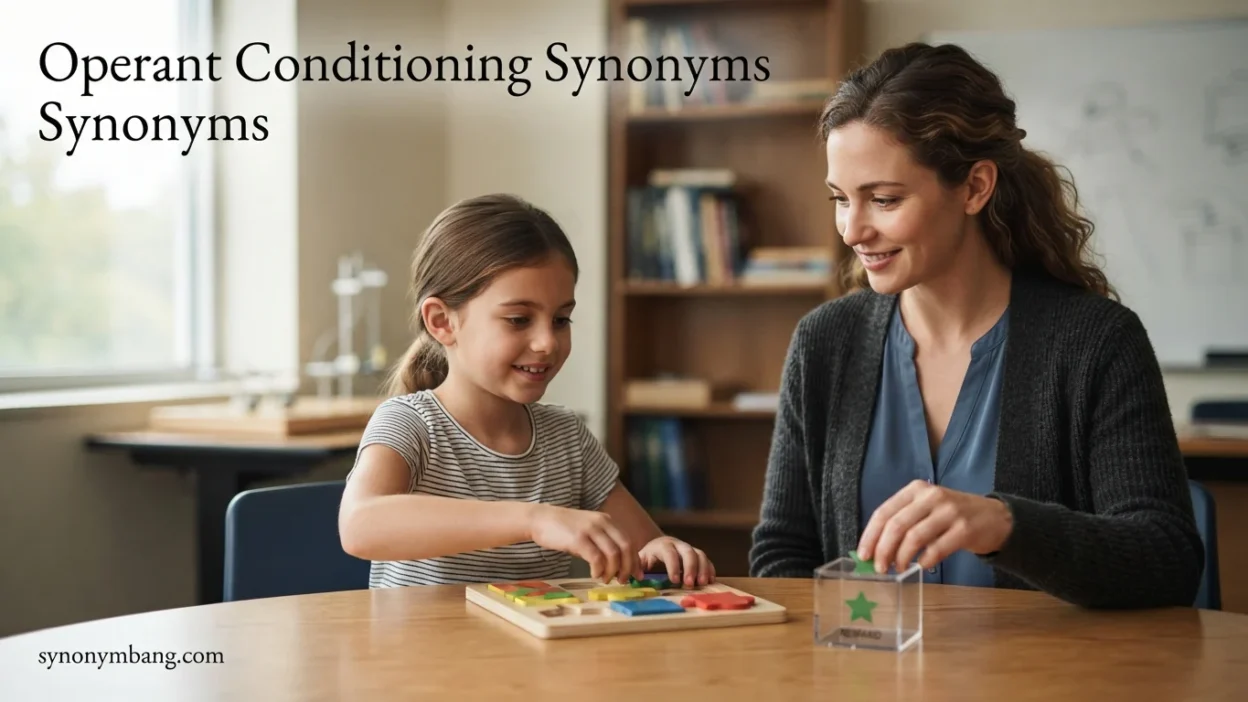
If you are searching for operant conditioning synonyms, you may be looking for alternative words, related concepts, or simpler ways to describe the process of learning through consequences. Operant conditioning is an important concept in psychology, education, parenting, animal training, and behavior management.
Unlike simple vocabulary words, “operant conditioning” is a technical psychological term. Because of this, there are not always exact one-word synonyms. Instead, several related terms describe different parts of the same learning process, including reinforcement, punishment, reward, consequence, behavior modification, and conditioning.
Understanding these related terms can help students, ESL learners, writers, and content creators explain behavioral learning more clearly and accurately.
What Does Operant Conditioning Mean?
Operant conditioning is a learning process in which behavior becomes more or less likely because of what happens after the behavior.
In simple English, a person or animal learns from the consequences of an action. If a consequence encourages the behavior, the behavior may happen more often. If a consequence discourages it, the behavior may happen less often.
For example, imagine a student completes homework and receives praise from a teacher. Because the praise is pleasant, the student may become more likely to complete homework again. This is an example of reinforcement.
Operant conditioning is strongly associated with behavioral psychology and the work of B. F. Skinner. However, the basic idea is easy to understand: behavior can change because of its consequences.
Are There Exact Synonyms for Operant Conditioning?
There is no single perfect synonym for operant conditioning because it is a specific psychological concept.
However, several words and phrases can be used as synonyms or closely related expressions depending on what you want to describe. Some refer to the overall learning process, while others describe specific mechanisms within it.
Here are 30 useful operant conditioning synonyms and related terms.
1. Behavioral Conditioning
Meaning: Learning in which behavior changes because of experience or consequences.
Example: Behavioral conditioning can influence how students respond to classroom rewards.
Best usage: Use this broad term when discussing behavior-based learning generally.
2. Behavior Modification
Meaning: Changing behavior by using techniques that encourage or discourage certain actions.
Example: The school introduced a behavior modification program to improve classroom habits.
Best usage: Common in education, psychology, parenting, and therapy.
3. Reinforcement
Meaning: A consequence that makes a behavior more likely to happen again.
Example: Praise served as reinforcement for the child’s helpful behavior.
Best usage: Use when the focus is on increasing a behavior.
4. Positive Reinforcement
Meaning: Adding something pleasant after a behavior to encourage it.
Example: The teacher used positive reinforcement by praising students who completed their work.
Best usage: Use when something desirable is added to strengthen behavior.
5. Negative Reinforcement
Meaning: Removing something unpleasant to make a behavior more likely.
Example: The annoying alarm stops when the person fastens the seat belt.
Best usage: Use when an unpleasant condition is removed after a behavior.
6. Punishment
Meaning: A consequence intended to make a behavior less likely.
Example: The punishment reduced the student’s tendency to break the classroom rule.
Best usage: Use when discussing consequences designed to decrease behavior.
7. Positive Punishment
Meaning: Adding an unpleasant consequence to reduce a behavior.
Example: A speeding driver may receive a fine after breaking the speed limit.
Best usage: Use in technical psychology discussions.
8. Negative Punishment
Meaning: Removing something desirable to reduce a behavior.
Example: The child lost screen time after repeatedly ignoring the household rule.
Best usage: Useful when explaining the removal of a privilege.
9. Consequence-Based Learning
Meaning: Learning that occurs because actions produce consequences.
Example: Consequence-based learning can shape habits over time.
Best usage: A simple explanatory phrase for general audiences.
10. Learning Through Consequences
Meaning: Learning by experiencing what happens after an action.
Example: Children often learn through consequences when they discover which behaviors receive positive responses.
Best usage: Excellent for ESL-friendly explanations.
11. Stimulus-Response Learning
Meaning: Learning involving a relationship between a stimulus and a behavioral response.
Example: Stimulus-response learning has been studied extensively in behavioral psychology.
Best usage: Use when discussing broader behaviorist learning theories.
12. Behavioral Learning
Meaning: Learning that can be observed through changes in behavior.
Example: Behavioral learning can occur when repeated consequences change a person’s actions.
Best usage: A broad term suitable for educational writing.
13. Instrumental Conditioning
Meaning: A form of learning in which behavior is influenced by its consequences.
Example: Instrumental conditioning can help explain why certain actions become repeated.
Best usage: Use as a closely related technical term, especially in psychology.
14. Instrumental Learning
Meaning: Learning in which an action helps produce a particular outcome.
Example: The animal demonstrated instrumental learning by repeating the action that produced food.
Best usage: Common in psychology and animal-learning research.
15. Reward-Based Learning
Meaning: Learning encouraged by rewards or desirable outcomes.
Example: Reward-based learning helped motivate the students to practice regularly.
Best usage: Use when rewards are the main focus.
16. Reward Conditioning
Meaning: Conditioning behavior through rewards or positive outcomes.
Example: Reward conditioning can encourage an animal to repeat a desired action.
Best usage: Useful in general discussions of training.
17. Reinforcement Learning
Meaning: Learning in which actions are strengthened or weakened according to their outcomes.
Example: Reinforcement learning is widely discussed in psychology and artificial intelligence.
Best usage: Use carefully because the term also has a specific meaning in machine learning.
18. Consequence Learning
Meaning: Learning based on the results that follow behavior.
Example: Consequence learning can influence everyday habits.
Best usage: Suitable for simple educational explanations.
19. Associative Learning
Meaning: Learning by forming connections between events, actions, or outcomes.
Example: Associative learning helps explain how repeated experiences influence behavior.
Best usage: Use as a broader psychological category rather than an exact synonym.
20. Behavior Shaping
Meaning: Gradually developing a desired behavior through reinforcement.
Example: The trainer used behavior shaping to teach the dog a complex task.
Best usage: Particularly useful when describing training.
21. Shaping
Meaning: Reinforcing successive steps that gradually lead toward a desired behavior.
Example: Shaping helped the trainer teach the animal to perform the complete action.
Best usage: Use in technical discussions of operant learning.
22. Contingency Learning
Meaning: Learning that occurs when a behavior is connected to a particular consequence.
Example: Contingency learning occurs when a student realizes that completing assignments leads to extra privileges.
Best usage: Best for academic or psychological contexts.
23. Behavioral Reinforcement
Meaning: Strengthening a behavior through a consequence.
Example: Behavioral reinforcement can increase the frequency of a useful habit.
Best usage: Use when reinforcement is the central idea.
24. Behavior-Based Learning
Meaning: Learning that focuses on observable actions and their consequences.
Example: Behavior-based learning is often discussed in classroom management.
Best usage: Helpful for general readers who may not know technical terminology.
25. Habit Formation
Meaning: The process of developing a repeated pattern of behavior.
Example: Consistent rewards can contribute to habit formation.
Best usage: Use when discussing repeated behaviors rather than the full psychological theory.
26. Behavioral Training
Meaning: Training designed to develop, strengthen, or reduce particular behaviors.
Example: Behavioral training helped the dog respond consistently to commands.
Best usage: Common in education, animal training, and workplace settings.
27. Behavior Change
Meaning: A change in how a person or animal acts.
Example: The reward system produced noticeable behavior change among participants.
Best usage: A broad, easy-to-understand expression.
28. Learning by Reinforcement
Meaning: Learning in which reinforcement influences future behavior.
Example: Learning by reinforcement can encourage students to repeat productive study habits.
Best usage: Useful when explaining operant conditioning in simple language.
29. Consequence-Based Conditioning
Meaning: Conditioning in which consequences influence whether behavior continues.
Example: Consequence-based conditioning can explain why certain habits become stronger.
Best usage: Helpful as an explanatory phrase, although it is not a strict technical synonym.
30. Operant Learning
Meaning: Learning in which behavior is influenced by the consequences that follow it.
Example: Operant learning explains how rewards and punishments can change future behavior.
Best usage: One of the closest alternatives to “operant conditioning.”
Operant Conditioning Synonyms Comparison Table
| Term | Main Idea | Best Used For |
| Behavioral conditioning | Behavior changes through experience | General psychology |
| Behavior modification | Deliberately changing behavior | Education and therapy |
| Reinforcement | Increasing behavior | Psychology |
| Positive reinforcement | Adding something desirable | Teaching and training |
| Negative reinforcement | Removing something unpleasant | Technical explanations |
| Punishment | Decreasing behavior | Psychology and discipline |
| Instrumental conditioning | Behavior produces consequences | Academic writing |
| Reward-based learning | Learning through rewards | Training and education |
| Reinforcement learning | Learning from outcomes | Psychology and AI |
| Behavior shaping | Gradually developing behavior | Training |
| Associative learning | Connecting experiences | General psychology |
| Habit formation | Developing repeated actions | Everyday behavior |
| Behavior change | Changing actions | General audiences |
| Operant learning | Learning through consequences | Psychology |
Operant Conditioning vs. Classical Conditioning
Operant conditioning and classical conditioning are both forms of learning, but they work differently.
Operant conditioning focuses on the consequences that follow a behavior. A behavior may become stronger because it is reinforced or weaker because it is punished.
Classical conditioning focuses on forming an association between stimuli. A person or animal learns to respond to one stimulus because it has become associated with another.
For example, receiving praise after completing homework is related to operant conditioning. Feeling nervous when hearing a sound previously associated with something unpleasant is more closely related to classical conditioning.
Reinforcement vs. Punishment
These two terms are often confused.
Reinforcement increases behavior.
Punishment decreases behavior.
The words “positive” and “negative” do not mean “good” and “bad” in this context.
Positive means something is added.
Negative means something is removed.
Therefore, positive reinforcement adds something desirable to increase behavior, while negative reinforcement removes something unpleasant to increase behavior.
How to Choose the Right Operant Conditioning Synonym
Choosing the right term depends on what part of the learning process you are discussing.
For General Readers
Use:
- Behavioral learning
- Behavior change
- Learning through consequences
- Consequence-based learning
- Behavior-based learning
These expressions are easy to understand and work well in introductory articles.
For Academic Psychology
Use:
- Operant learning
- Instrumental conditioning
- Instrumental learning
- Reinforcement
- Punishment
- Contingency learning
These terms are more appropriate for academic and scientific discussions.
When Talking About Increasing Behavior
Use:
- Reinforcement
- Positive reinforcement
- Negative reinforcement
- Reward-based learning
- Learning by reinforcement
These terms focus on behaviors becoming more likely.
When Talking About Decreasing Behavior
Use:
- Punishment
- Positive punishment
- Negative punishment
- Behavior modification
These terms are useful when explaining methods for reducing unwanted behavior.
When Talking About Training
Use:
- Behavior shaping
- Shaping
- Behavioral training
- Reward conditioning
- Reinforcement
These are particularly useful in discussions about teaching people or animals new behaviors.
Why Understanding These Terms Matters
Knowing the difference between related psychological terms is important because using the wrong word can change the meaning of an explanation.
For example, reinforcement is not the same as reward, even though rewards can be used as reinforcement. Reinforcement specifically refers to a consequence that increases the likelihood of a behavior.
Similarly, negative reinforcement is not punishment. Negative reinforcement removes something unpleasant to increase behavior, while punishment is intended to decrease behavior.
These distinctions are especially important in academic writing, psychology assignments, classroom discussions, and educational content.
Common Mistakes When Using Operant Conditioning Terms
One common mistake is treating every related word as an exact synonym. Terms such as “behavior modification,” “reinforcement,” and “habit formation” overlap with operant conditioning, but they do not have exactly the same meaning.
Another common mistake is believing that positive reinforcement means something is morally good. In psychology, “positive” simply means that something is added.
The same applies to “negative reinforcement.” Negative does not mean bad. It means that something is removed.
A final mistake is confusing punishment with reinforcement. Reinforcement increases a behavior, while punishment decreases it.
Simple Example of Operant Conditioning
Imagine a child regularly cleans their room. Each time the child finishes, a parent gives praise.
The praise is a consequence of the behavior. If the child becomes more likely to clean the room because of that praise, the praise is functioning as positive reinforcement.
This simple example shows why consequences matter in operant conditioning.
Final Takeaway
The best operant conditioning synonyms depend on the context. There is no single word that perfectly replaces the technical term in every situation.
For general writing, phrases such as behavioral learning, learning through consequences, behavior change, and consequence-based learning are easy to understand.
For academic psychology, operant learning, instrumental conditioning, reinforcement, punishment, shaping, and contingency learning are more precise.
The most important point is to understand what each term actually describes. When you know if the focus is on increasing behavior, decreasing behavior, rewards, consequences, or gradual behavior change, choosing the right term becomes much easier.

Hello, I’m Isabella Collins, a language enthusiast passionate about helping readers discover accurate synonyms and enrich their vocabulary. I create clear, practical content that makes English writing easier, stronger, and more expressive.