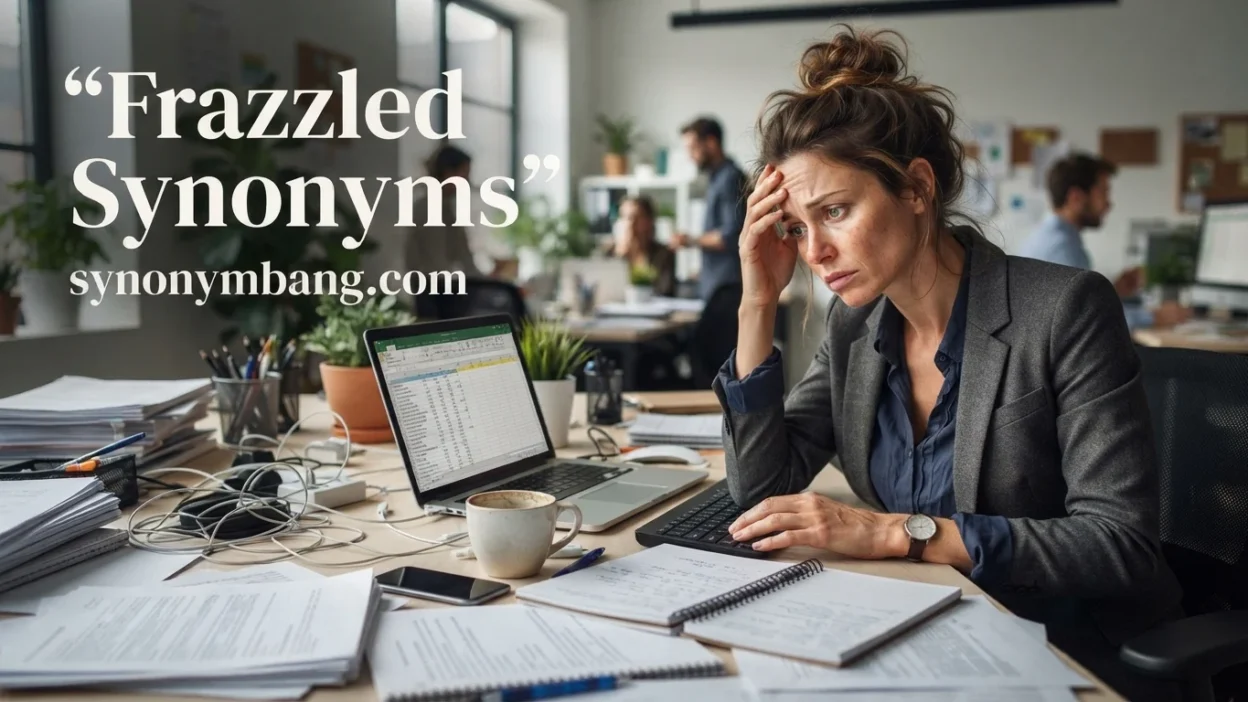
When someone feels frazzled, they are usually stressed, tired, confused, or emotionally overwhelmed. The word describes a state where too many problems, tasks, or pressures make it difficult to think clearly and stay calm. For example, someone rushing to finish work while answering messages and dealing with unexpected problems may feel completely frazzled.
Learning frazzled synonyms can help you express different levels and types of stress more precisely. Some alternatives focus on mental confusion, while others describe nervousness, exhaustion, worry, or emotional pressure. Choosing the right word can make your writing and everyday communication much clearer.
In this guide, you will find 30 useful synonyms for frazzled, with simple meanings, example sentences, and practical usage contexts. These words are helpful for students, ESL learners, writers, and anyone who wants to expand their English vocabulary.
What Does Frazzled Mean?
Frazzled is an adjective that means extremely stressed, nervous, tired, or mentally overwhelmed.
It is commonly used when someone has experienced too much pressure and is struggling to remain calm or organized.
Example:
“After dealing with three urgent problems at work, Maria felt completely frazzled.”
The tone of frazzled is usually informal and conversational. It often describes temporary emotional or mental stress rather than a permanent personality trait.
30 Frazzled Synonyms
1. Stressed
Meaning: Feeling worried or under pressure.
Example: “I was stressed because I had several assignments due.”
Best usage context: Everyday conversations about pressure and responsibilities.
2. Overwhelmed
Meaning: Feeling unable to manage everything because there is too much happening.
Example: “She felt overwhelmed by all the work waiting for her.”
Best usage context: Heavy workloads, responsibilities, or emotional pressure.
3. Distraught
Meaning: Extremely upset and unable to think calmly.
Example: “He was distraught after hearing the unexpected news.”
Best usage context: Serious emotional distress or upsetting situations.
4. Flustered
Meaning: Nervous and confused, especially because something unexpected happened.
Example: “She became flustered when everyone started asking questions.”
Best usage context: Awkward, rushed, or unexpected situations.
5. Agitated
Meaning: Feeling nervous, restless, or upset.
Example: “The customer became agitated after waiting for an hour.”
Best usage context: Visible irritation, restlessness, or emotional tension.
6. Anxious
Meaning: Worried or nervous about something that may happen.
Example: “He felt anxious before his important interview.”
Best usage context: Future concerns, uncertainty, or nervous anticipation.
7. Nervous
Meaning: Worried, uneasy, or afraid about something.
Example: “I was nervous before giving my presentation.”
Best usage context: Common everyday situations involving worry or uncertainty.
8. Frazzled
Meaning: Extremely stressed, tired, or mentally overwhelmed.
Example: “After a long day of meetings, I was completely frazzled.”
Best usage context: Informal descriptions of intense temporary stress.
9. Confused
Meaning: Unable to understand or think clearly.
Example: “She felt confused after receiving several different instructions.”
Best usage context: Mental uncertainty or lack of understanding.
10. Distracted
Meaning: Unable to concentrate because your attention is elsewhere.
Example: “He was too distracted to finish the report.”
Best usage context: Lack of focus caused by thoughts, problems, or surroundings.
11. Overburdened
Meaning: Having too many responsibilities or problems to handle comfortably.
Example: “The manager felt overburdened by the growing workload.”
Best usage context: Work, responsibilities, duties, and long-term pressure.
12. Exhausted
Meaning: Extremely tired physically or mentally.
Example: “She was exhausted after working all weekend.”
Best usage context: Physical or mental tiredness after sustained effort.
13. Tense
Meaning: Nervous, worried, or unable to relax.
Example: “Everyone felt tense before the final announcement.”
Best usage context: Situations filled with pressure or nervousness.
14. Restless
Meaning: Unable to relax or remain still.
Example: “He felt restless while waiting for the results.”
Best usage context: Impatience, nervous energy, or difficulty relaxing.
15. Rattled
Meaning: Shaken or upset by something unexpected.
Example: “The sudden accident left her rattled.”
Best usage context: Shock, surprise, or an unsettling event.
16. Unsettled
Meaning: Worried, uncomfortable, or emotionally disturbed.
Example: “The strange message left him feeling unsettled.”
Best usage context: Uneasiness caused by uncertainty or unusual events.
17. Worried
Meaning: Thinking about something with fear or concern.
Example: “She was worried about missing the deadline.”
Best usage context: General concern about a person, situation, or future event.
18. Harried
Meaning: Feeling stressed because you are being rushed or have too many things to do.
Example: “The harried employee rushed from one meeting to another.”
Best usage context: Busy schedules, deadlines, and constant demands.
19. Hectic
Meaning: Extremely busy, rushed, and full of activity.
Example: “It was a hectic morning at the office.”
Best usage context: Describing a situation, schedule, day, or environment rather than a person directly.
20. Pressured
Meaning: Feeling forced or pushed by difficult demands.
Example: “She felt pressured to complete the project early.”
Best usage context: Deadlines, expectations, competition, or demanding circumstances.
21. Overwrought
Meaning: Extremely emotional, worried, or upset.
Example: “He became overwrought after hearing the disturbing news.”
Best usage context: Formal or literary writing about intense emotions.
22. Nervous-wrecked
Meaning: Extremely nervous or emotionally strained.
Example: “The long wait had left him nervous-wrecked.”
Best usage context: Strong informal descriptions of intense nervousness.
23. Frazzled-looking
Meaning: Appearing tired, stressed, or disorganized.
Example: “She arrived looking frazzled after dealing with traffic.”
Best usage context: Describing someone’s visible appearance or condition.
24. Beset
Meaning: Troubled or surrounded by many difficulties.
Example: “The small business was beset by financial problems.”
Best usage context: Formal writing about serious or multiple difficulties.
25. Strained
Meaning: Under pressure or experiencing difficulty.
Example: “He sounded strained during the difficult conversation.”
Best usage context: Emotional pressure, relationships, resources, or difficult circumstances.
26. Overextended
Meaning: Having taken on more work or responsibility than you can comfortably manage.
Example: “She became overextended after accepting too many projects.”
Best usage context: Workload, commitments, finances, or responsibilities.
27. Discombobulated
Meaning: Confused and unable to organize your thoughts properly.
Example: “I felt completely discombobulated after waking up from the long flight.”
Best usage context: Informal and humorous descriptions of confusion.
28. Perturbed
Meaning: Worried, disturbed, or bothered by something.
Example: “He was perturbed by the sudden change in plans.”
Best usage context: Formal or polished writing.
29. Flustered and anxious
Meaning: Nervous and confused because of pressure or uncertainty.
Example: “She felt flustered and anxious before speaking to the audience.”
Best usage context: Situations involving both nervousness and confusion.
30. Mentally drained
Meaning: Extremely tired because of prolonged thinking, stress, or emotional effort.
Example: “After solving problems all day, I felt mentally drained.”
Best usage context: Mental exhaustion after demanding work or emotional situations.
Frazzled Synonyms Comparison Guide
| Synonym | Main Meaning | Tone | Best Used For |
| Stressed | Under pressure | Neutral | Everyday situations |
| Overwhelmed | Unable to manage everything | Neutral | Heavy responsibilities |
| Flustered | Nervous and confused | Informal | Unexpected situations |
| Distraught | Extremely upset | Strong | Serious emotional distress |
| Anxious | Worried or nervous | Neutral | Future concerns |
| Agitated | Restless or upset | Neutral | Irritation and tension |
| Exhausted | Extremely tired | Neutral | Physical or mental fatigue |
| Rattled | Shaken or disturbed | Informal | Sudden events |
| Harried | Rushed and pressured | Formal | Busy schedules |
| Tense | Unable to relax | Neutral | Pressure and nervousness |
| Overburdened | Carrying too many responsibilities | Formal | Work and duties |
| Discombobulated | Confused and disorganized | Informal | Mental confusion |
| Perturbed | Bothered or disturbed | Formal | Polished writing |
| Mentally drained | Mentally exhausted | Neutral | Prolonged mental effort |
How to Choose the Right Synonym for Frazzled
Choosing the right synonym depends on why someone feels frazzled and what aspect of the feeling you want to emphasize.
For General Stress
Use stressed, pressured, strained, or tense.
These words work well when someone is dealing with deadlines, responsibilities, work problems, or everyday pressure.
Example:
“I’ve been stressed because of my upcoming exams.”
For Feeling Like Everything Is Too Much
Choose overwhelmed, overburdened, or overextended.
These words are useful when a person has too many tasks, commitments, or responsibilities.
Example:
“She felt overwhelmed by everything she had to complete.”
For Nervousness and Confusion
Use flustered, anxious, nervous, or discombobulated.
These alternatives are especially useful when someone cannot think clearly because of nervousness or an unexpected situation.
Example:
“He became flustered when the interviewer asked an unexpected question.”
For Strong Emotional Distress
Choose distraught, overwrought, agitated, or perturbed.
These words communicate stronger emotional reactions and are often suitable for serious situations or formal writing.
Example:
“The family was distraught after receiving the news.”
For Mental or Physical Exhaustion
Use exhausted, mentally drained, or overextended.
These words are better when the main issue is tiredness rather than nervousness.
Example:
“After studying for twelve hours, she was mentally drained.”
For Sudden Shock or Surprise
Choose rattled or unsettled.
These words are useful when an unexpected event makes someone lose their sense of calm.
Example:
“The sudden change in plans left everyone unsettled.”
Frazzled vs. Stressed
Frazzled and stressed are closely related, but they are not always interchangeable.
Stressed is a broad word for feeling pressure or worry. Frazzled usually suggests that the pressure has become intense enough to make someone tired, confused, nervous, or disorganized.
Example:
“I am stressed about my exam.”
This simply means the exam is causing worry.
“I am frazzled after studying, working, and dealing with problems all day.”
This suggests a stronger state of mental and emotional overload.
Frazzled vs. Overwhelmed
Overwhelmed focuses on having more responsibilities, emotions, or problems than you can comfortably handle.
Frazzled often emphasizes the visible or mental effect of that pressure, such as confusion, nervousness, tiredness, or disorganization.
For example:
“The new employee felt overwhelmed by the amount of work.”
“She looked frazzled after trying to finish everything before lunch.”
Both words are useful, but they highlight slightly different aspects of pressure.
Frazzled vs. Flustered
Flustered usually describes a temporary state of nervous confusion, often caused by an unexpected event.
Frazzled can describe a broader and more sustained feeling of stress and exhaustion.
Flustered: “I became flustered when I forgot my presentation notes.”
Frazzled: “After a week of deadlines, I felt completely frazzled.”
Common Mistakes When Using Frazzled Synonyms
One common mistake is assuming every synonym has exactly the same meaning. Synonyms often overlap, but each word can communicate a slightly different emotion.
For example, exhausted mainly describes extreme tiredness, while anxious focuses on worry. Distraught communicates much stronger emotional distress, while distracted mainly refers to difficulty concentrating.
Another mistake is using formal words in casual conversations when a simpler alternative would sound more natural. Words such as perturbed, overwrought, and beset can work well in formal writing, while stressed, nervous, and overwhelmed are more common in everyday English.
Why Learning Frazzled Synonyms Matters
Understanding different words for stress and emotional pressure improves vocabulary precision. Instead of repeatedly saying someone is “stressed,” you can explain exactly what they are experiencing.
A student might be anxious before an exam, overwhelmed by too much homework, flustered during a difficult presentation, or mentally drained after studying for hours.
Writers can also use these distinctions to create more realistic descriptions. The right synonym gives readers a clearer picture of a person’s emotional state without needing a long explanation.
Final Thoughts on Frazzled Synonyms
The word frazzled describes a state of intense stress, tiredness, nervousness, or mental overload. Its meaning can overlap with words such as stressed, overwhelmed, flustered, anxious, rattled, exhausted, and mentally drained, but each alternative has its own shade of meaning.
For everyday situations, stressed, overwhelmed, nervous, and flustered are natural choices. For formal writing, words such as perturbed, overwrought, overburdened, and beset may be more appropriate. When the focus is mental exhaustion, mentally drained or exhausted can communicate the idea more precisely.
Learning these frazzled synonyms gives you more flexibility in conversations, academic writing, creative work, and professional communication. The best synonym is the one that accurately matches the emotion, intensity, and context you want to express.

I’m Grace Walker, the Administrator at SynonymBang. I manage daily operations, ensure content quality, support our editorial team, and strive to provide reliable synonym resources that help readers communicate with confidence.