

Choosing between interested in and interested on can be confusing, especially for English learners who find prepositions difficult. Although both expressions may seem possible, only interested in is the standard grammatical choice when expressing curiosity, enthusiasm, attraction, or a desire to learn more about something.
For example, you should say, “I am interested in science,” not “I am interested on science.” This small preposition difference can make your English sound more natural and accurate.
The confusion often comes from other familiar expressions, such as focused on, working on, and information on, where on is grammatically correct. However, these phrases follow different grammatical patterns.
Understanding why interested in or interested on is a common grammar question will help you choose the right expression in conversations, academic assignments, professional emails, and everyday writing. In this guide, you will learn the meaning, grammar rules, differences, common mistakes, and practical examples to use the phrase confidently.
Quick Answer: Interested In or Interested On?
Interested in is the correct expression in standard English. Use it to describe curiosity, enthusiasm, attraction, or attention toward a person, subject, activity, or opportunity. For example, “She is interested in learning Spanish.” Interested on is generally grammatically incorrect when expressing these meanings in both American and British English.
Why Do People Confuse Interested In and Interested On?
People often confuse interested in or on because English prepositions do not always follow predictable rules. The words in, on, at, and about appear in many expressions, but their correct usage depends on the adjective or verb they accompany.
For example, English speakers naturally say:
- Interested in music.
- Focused on studies.
- Working on a project.
- Information on technology.
- Curious about something.
Because on is correct in several expressions related to subjects and activities, learners sometimes assume it can also follow interested. However, standard English uses the fixed adjective-preposition combination interested in.
Another reason is direct translation from other languages. A preposition that sounds natural in one language may not be appropriate in English.
The easiest solution is to learn interested in as one complete expression rather than trying to choose its preposition through translation.
What Does Interested In Mean?

Interested in means having curiosity, enthusiasm, attention, or a desire to learn more about someone or something. It can also describe attraction or willingness to become involved in an activity, opportunity, or situation.
The expression is formed using the adjective interested followed by the preposition in.
Examples:
- I am interested in psychology.
- She is interested in learning Spanish.
- Are you interested in this opportunity?
- They are interested in joining our team.
- My brother is interested in computer programming.
Common Uses of Interested In
The expression appears in several everyday situations.
- Academic interests: She is interested in biology and mathematics.
- Career opportunities: I am interested in applying for this position.
- Hobbies and activities: He is interested in photography.
- Romantic attraction: She is interested in him.
- Business opportunities: We are interested in your proposal.
- Personal development: I am interested in improving my communication skills.
What Comes After Interested In?
The expression interested in can be followed by a noun, pronoun, or gerund (verb ending in -ing).
| Structure | Example |
| Interested in + noun | I am interested in science. |
| Interested in + pronoun | She is interested in him. |
| Interested in + gerund | He is interested in swimming. |
| Interested in + noun phrase | We are interested in your business proposal. |
Remember that when a verb follows interested in, you normally use its -ing form, not its base form.
- Correct: I am interested in learning English.
- Incorrect: I am interested in learn English.
What Does Interested On Mean?
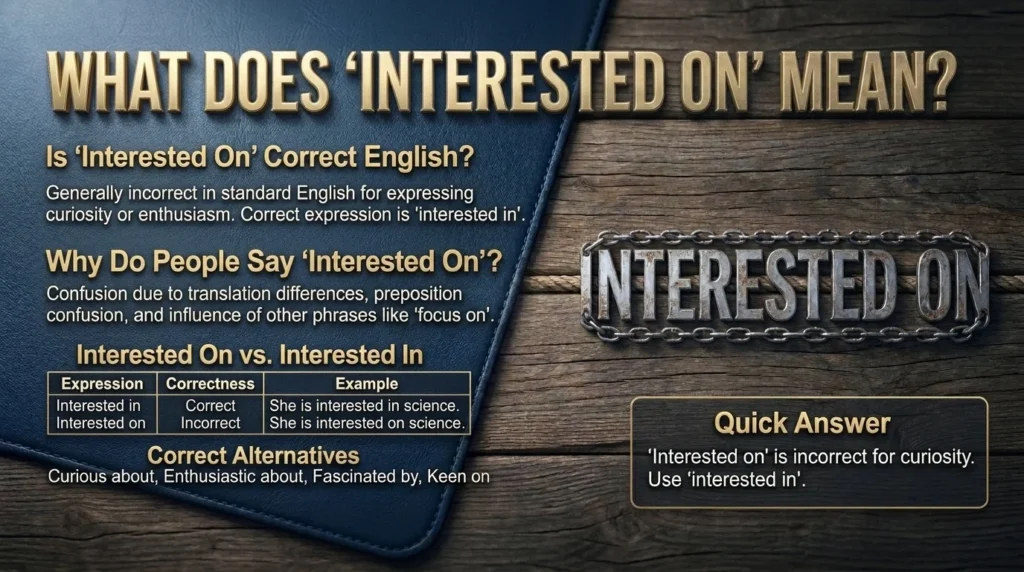
Interested on is not a standard English expression when you want to describe curiosity, enthusiasm, attraction, or attention toward something.
The adjective interested normally takes the preposition in. Using on directly after it creates an unnatural or grammatically incorrect expression in this context.
Incorrect examples:
- I am interested on football.
- She is interested on your idea.
- He is interested on getting a new job.
- We are interested on this project.
Correct alternatives:
- I am interested in football.
- She is interested in your idea.
- He is interested in getting a new job.
- We are interested in this project.
Can On Ever Appear in a Sentence With Interested?
Yes. Although interested on is not the correct combination, on can appear later in the same sentence when it belongs to another expression.
For example:
“She is interested in working on a new project.”
In this sentence:
- Interested in is the correct adjective-preposition combination.
- Working on is another correct expression describing work being done on something.
Similarly:
- I am interested in focusing on my studies.
- They are interested in working on new technology.
- He is interested in writing a book on history.
This distinction is important because the problem is not the word on itself. The problem is using it directly after interested.
Interested In vs. Interested On: Comparison Table
| Feature | Interested In | Interested On |
| Grammatical status | Correct | Incorrect in this context |
| Main meaning | Curiosity or enthusiasm | No standard equivalent meaning |
| Preposition | In | On |
| With hobbies | Interested in music | Incorrect |
| With subjects | Interested in science | Incorrect |
| With activities | Interested in swimming | Incorrect |
| With people | Interested in someone | Incorrect |
| With opportunities | Interested in a job | Incorrect |
| American English | Standard | Nonstandard |
| British English | Standard | Nonstandard |
Key difference: Use interested in whenever you want to express curiosity, attraction, enthusiasm, or willingness to explore something. Do not replace in with on in this expression.
When Should You Use Interested In or Interested On?
Knowing the correct expression becomes easier when you understand the situations in which it is commonly used.
1. When Talking About Academic Interests
Use interested in when discussing school subjects, educational opportunities, or topics you want to study.
Examples:
- She is interested in biology.
- He is interested in studying abroad.
- I am interested in learning mathematics.
- The students are interested in environmental science.
2. When Discussing Careers and Job Applications
Use the phrase when expressing professional interest in a job, company, or career opportunity.
Examples:
- I am interested in the marketing position.
- She is interested in becoming a teacher.
- We are interested in working with your company.
- He is interested in developing new business skills.
3. When Talking About Hobbies and Activities
Use interested in to describe activities you enjoy or want to explore.
Examples:
- I am interested in photography.
- They are interested in playing football.
- My friend is interested in painting.
- She is interested in learning how to cook.
4. When Expressing Romantic Interest
The expression can also describe attraction or romantic feelings toward another person.
Examples:
- He is interested in her.
- Are you interested in someone?
- She seems interested in that guy.
- I think he is interested in getting to know you.
5. When Discussing Business and Professional Opportunities
In professional communication, interested in expresses willingness to consider an offer, partnership, or proposal.
Examples:
- We are interested in your business proposal.
- The company is interested in expanding its operations.
- I am interested in discussing this opportunity.
- Our team is interested in collaborating with your organization.
When Should You Use Interested On?
You should avoid interested on when expressing curiosity or enthusiasm. Instead, select the correct expression based on the meaning you want.
For example:
- Interested in technology (curiosity).
- Focused on technology (concentration).
- Working on technology (performing work).
- A book on technology (a book about that subject).
These examples show that in and on can both be correct in English, but they cannot be used interchangeably.
15 Examples of Interested In and Interested On in Sentences
The following examples show how to correct common mistakes and use interested in naturally.
| Incorrect Expression | Correct Expression |
| I am interested on music. | I am interested in music. |
| She is interested on science. | She is interested in science. |
| He is interested on football. | He is interested in football. |
| I am interested on learning English. | I am interested in learning English. |
| They are interested on business. | They are interested in business. |
| We are interested on your idea. | We are interested in your idea. |
| She is interested on photography. | She is interested in photography. |
| He is interested on traveling. | He is interested in traveling. |
| I am interested on this job. | I am interested in this job. |
| They are interested on technology. | They are interested in technology. |
More Natural Examples Using Interested In
- I have always been interested in learning about different cultures.
- Are you interested in joining our English course?
- My sister is interested in becoming a professional writer.
- We are interested in hearing your opinion.
- He is not interested in watching television.
- The students are interested in exploring new ideas.
- She has been interested in fashion since childhood.
- I am very interested in improving my writing skills.
These examples demonstrate how the expression works in casual conversations, educational settings, and professional situations.
Common Mistakes to Avoid
Even people with good English skills can sometimes make mistakes with prepositions. Here are some common errors and their correct forms.
1. Using On Instead of In
The most common mistake is replacing in with on.
- Incorrect: I am interested on photography.
- Correct: I am interested in photography.
Always use in when expressing interest in something.
2. Using the Base Verb Instead of the Gerund
When a verb follows interested in, use the -ing form.
- Incorrect: She is interested in learn English.
- Correct: She is interested in learning English.
Other examples:
- Interested in reading.
- Interested in traveling.
- Interested in studying.
3. Confusing Interested In With Information On
The word on is correct when introducing the subject of information, a book, or a discussion.
For example:
- Correct: I am interested in climate change.
- Correct: I found information on climate change.
- Correct: She wrote a book on economics.
The difference is grammatical structure. Use interested in to describe curiosity and information on to introduce a subject.
4. Using Interested For Instead of Interested In
Another common preposition mistake is using for after interested.
- Incorrect: I am interested for this course.
- Correct: I am interested in this course.
However, for can appear in a different structure:
“I have an interest in applying for this course.”
Here, in follows interest, while for belongs to applying for.
5. Confusing Interested In With Interest On
The noun interest follows a similar pattern.
- Incorrect: I have an interest on science.
- Correct: I have an interest in science.
- Correct: There is strong interest in the project.
Both interested in and an interest in are standard expressions.
Memory Trick: How to Remember Interested In
The easiest way to remember the correct expression is to memorize interested in as a fixed pair.
Think of these examples:
- Interested in music.
- Interested in learning.
- Interested in business.
- Interested in someone.
- Interested in a new opportunity.
You can also use this simple memory trick:
Interested IN = Curious ABOUT something.
Whenever you want to explain that someone likes a subject, wants to learn more, or feels attracted to something, remember to use in.
With regular practice, this expression will become natural in your everyday English.
American vs. British English: Is There Any Difference?
There is no grammatical difference between American and British English when using interested in. Both varieties follow the same adjective-preposition combination.
| English Variety | Correct Expression | Example |
| American English | Interested in | I am interested in sports. |
| British English | Interested in | I am interested in sport. |
The word sports is common in American English, while sport is often used as a general term in British English.
However, this difference does not affect the preposition. Interested in is the correct expression in both varieties.
Whether you are writing for readers in the United States, United Kingdom, Canada, Australia, or elsewhere, use interested in.
Similar Words and Expressions Related to Interested In
If you want to improve your vocabulary, several expressions can communicate similar ideas to interested in. However, they may have slightly different meanings and use different prepositions.
| Expression | Meaning | Example |
| Curious about | Wanting to know more | I am curious about space. |
| Keen on | Enthusiastic about something | She is keen on photography. |
| Passionate about | Having strong enthusiasm | He is passionate about music. |
| Fascinated by | Extremely interested in something | She is fascinated by history. |
| Fond of | Having a liking for something | I am fond of reading. |
| Drawn to | Feeling attracted to something | He is drawn to creative work. |
| Engaged in | Actively involved in something | They are engaged in research. |
| Focused on | Concentrating on something | She is focused on her career. |
| Enthusiastic about | Showing excitement | We are enthusiastic about the project. |
| Concerned with | Related to or dealing with something | The discussion is concerned with education. |
Important: These expressions are related in meaning, but they are not always interchangeable. For example, focused on describes concentration, while interested in describes curiosity or enthusiasm.
Final Verdict: Interested In or Interested On?
Use interested in, not interested on, to express curiosity, enthusiasm, attraction, or interest in hobbies, subjects, and opportunities.
Use interested in + noun, pronoun, or gerund to form grammatically correct sentences.
- Correct! “I am interested in art.” is grammatically correct.
- Interested in = shows curiosity or enthusiasm about something.
- Example: “I am interested in art because I enjoy painting and drawing.”
- ❌ I am interested on art.
- ✅ I am interested in art.
- Interested in is the correct preposition.
- They are interested in this opportunity.
For example:
Although on is correct in expressions such as focused on, working on, and information on, it should not replace in after the adjective interested.
Frequently Asked Questions (FAQs)
She is interested in learning English.
Interested in is correct in standard English. Use it when describing curiosity, enthusiasm, or attraction toward something. For example, “I am interested in music.” Interested on is generally incorrect in this context.
2. Why do we say interested in instead of interested on?
English has established adjective-preposition combinations called collocations. The adjective interested naturally takes in when expressing curiosity or enthusiasm. Therefore, interested in is the standard grammatical construction.
3. Can I say I am interested on learning English?
No. The correct sentence is “I am interested in learning English.” When a verb follows interested in, use the gerund form (verb + -ing) rather than the base form.
4. Is interested about grammatically correct?
In standard English, interested in is the usual expression when describing curiosity or enthusiasm. Although you may encounter interested about in some contexts, it is generally less natural for this meaning. For example, say “I am interested in science” rather than “I am interested about science.”
5. What is the difference between interested in and focused on?
Interested in expresses curiosity, enthusiasm, or attraction, while focused on describes concentration or giving attention to a particular task or subject.
Examples:
- I am interested in mathematics. (I want to learn more about it.)
- I am focused on mathematics. (I am concentrating on it.)
6. Is interested in formal or informal English?
Interested in is appropriate in both formal and informal English. You can use it in everyday conversations, academic assignments, job applications, business emails, and professional communication.
7. Can interested in be followed by a verb?
Yes. When a verb follows interested in, use its -ing form.
Examples:
- I am interested in reading.
- She is interested in traveling.
- They are interested in learning English.
- We are interested in starting a business.
8. Is interested in correct in both American and British English?
Yes. Both American and British English use interested in. There is no difference in the preposition, and interested on is not a standard alternative in either variety.
Remember This
- Interested in = Correct standard English.
- Interested on = Incorrect for expressing curiosity or enthusiasm.
- Interested about = Usually less natural than interested in.
- Use interested in + noun, pronoun, or gerund.
- Use in before an -ing verb.
- American and British English follow the same rule.
Example to remember: I am interested in improving my English.
Conclusion
Understanding the difference between interested in or interested on becomes easy when you learn the correct preposition. In standard English, interested in is the accepted expression for describing curiosity, enthusiasm, attraction, or willingness to explore something. if you are discussing hobbies, education, careers, relationships, or business opportunities, use in after interested. The expression works with nouns, pronouns, and gerunds, making it useful in almost every type of communication.
Remember that English prepositions often follow established usage patterns rather than simple logical rules. Although on is correct in expressions such as focused on, working on, and information on, it does not normally follow interested directly.
Practice using interested in in your everyday conversations and writing, and you will avoid this common grammar mistake while communicating more naturally and confidently.

Hi, I’m Nathan Cooper, a language enthusiast passionate about synonyms and vocabulary. I create clear, accurate, and engaging content that helps readers expand their word knowledge and communicate with confidence every day.