
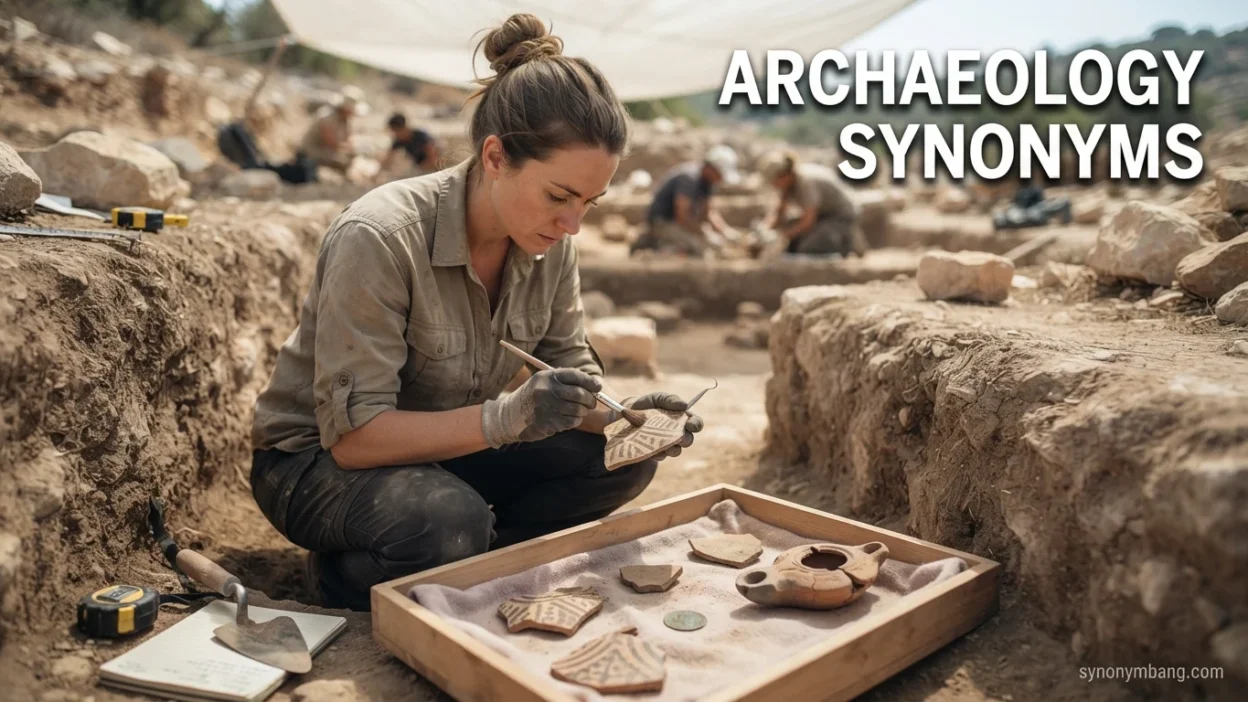
If you are searching for archaeology synonyms, you may be looking for different words that describe the study of ancient human life, artifacts, ruins, cultures, and historical remains. Archaeology is a specialized field, so it does not have many perfect one-word synonyms. However, several related terms can describe particular parts of archaeological study.
Learning these words is useful for students, ESL learners, writers, researchers, and content creators. Understanding the difference between terms such as archaeology, antiquarianism, excavation, paleontology, and anthropology can help you write more accurately and avoid confusing related subjects.
This guide explains 30 useful synonyms, near-synonyms, and related terms connected with archaeology. Each term includes a simple meaning, an example sentence, and the situation where it is most appropriate.
What Does “Archaeology” Mean?
Archaeology is the study of past human life and cultures through physical remains and material evidence.
Archaeologists may study objects such as pottery, tools, weapons, buildings, coins, bones, artwork, graves, and other remains. They use this evidence to understand how people lived, worked, traveled, traded, worshiped, and organized their communities.
For example:
Archaeology helps researchers understand how ancient civilizations lived.
The word archaeology is usually used as the name of an academic discipline or field of study.
Archaeology: Tone and Usage
The word archaeology has a formal, academic, and scientific tone. It is commonly used in history, anthropology, museums, universities, research papers, documentaries, and educational writing.
There is an important distinction between synonyms and related terms. Words such as excavation and artifact study are connected with archaeology, but they do not mean exactly the same thing as the entire field.
30 Archaeology Synonyms and Related Terms
1. Antiquarianism
Meaning: The study or collection of old objects, documents, and historical remains.
Example: Antiquarianism played an important role in the early study of ancient artifacts.
Best usage context: Historical discussions about the study of antiquities.
2. Archaeological Study
Meaning: Research into past human societies using physical evidence.
Example: The archaeological study revealed new information about the ancient settlement.
Best usage context: Academic and research writing.
3. Archaeological Research
Meaning: Systematic investigation of past human life and material remains.
Example: Archaeological research continues at the ancient site.
Best usage context: Academic papers and professional writing.
4. Excavation
Meaning: The careful digging and removal of soil to discover buried remains.
Example: The excavation uncovered several ancient pottery pieces.
Best usage context: Fieldwork and archaeological discoveries.
5. Archaeological Excavation
Meaning: Organized digging carried out to study historical or ancient remains.
Example: The archaeological excavation lasted several months.
Best usage context: Professional archaeology.
6. Artifact Studies
Meaning: Examination of objects made or used by humans in the past.
Example: Artifact studies helped researchers understand ancient trade routes.
Best usage context: Museums, research, and academic writing.
7. Material Culture Studies
Meaning: The study of physical objects created or used by people.
Example: Material culture studies can reveal how ancient families lived.
Best usage context: Archaeology and anthropology.
8. Historical Archaeology
Meaning: The study of past societies using archaeological evidence together with written history.
Example: Historical archaeology can combine old documents with physical remains.
Best usage context: Archaeological research involving documented history.
9. Prehistoric Archaeology
Meaning: The study of human societies from periods before written records.
Example: Prehistoric archaeology helps researchers investigate early human communities.
Best usage context: Prehistory and ancient human societies.
10. Classical Archaeology
Meaning: The study of ancient Greek and Roman cultures through physical remains.
Example: She specializes in classical archaeology and ancient Roman architecture.
Best usage context: Greek and Roman history.
11. Underwater Archaeology
Meaning: The study of human remains and artifacts found underwater.
Example: Underwater archaeology helped locate an ancient shipwreck.
Best usage context: Shipwrecks, submerged settlements, and maritime history.
12. Maritime Archaeology
Meaning: The study of human interaction with seas, rivers, ships, and waterways through archaeological evidence.
Example: Maritime archaeology provides information about ancient seafaring.
Best usage context: Ships, ports, trade, and coastal societies.
13. Historical Research
Meaning: The investigation of events and societies from the past.
Example: Historical research helped place the archaeological discovery in context.
Best usage context: Broader historical studies.
14. Antiquities Research
Meaning: The study of ancient objects, buildings, and remains.
Example: Antiquities research revealed the object’s possible origin.
Best usage context: Ancient objects and heritage studies.
15. Ancient History Studies
Meaning: The study of people, societies, and events from the ancient past.
Example: Ancient history studies often use archaeological evidence.
Best usage context: Ancient civilizations and historical education.
16. Heritage Studies
Meaning: The study of cultural, historical, and archaeological heritage.
Example: Heritage studies examine how ancient sites are preserved.
Best usage context: Cultural preservation and historical sites.
17. Cultural Heritage Research
Meaning: Research into places, objects, traditions, and remains valued as part of cultural history.
Example: Cultural heritage research helped document the endangered site.
Best usage context: Preservation, museums, and cultural studies.
18. Archaeometry
Meaning: The use of scientific and technological methods to study archaeological materials.
Example: Archaeometry was used to determine the composition of the ancient pottery.
Best usage context: Scientific archaeology and laboratory research.
19. Bioarchaeology
Meaning: The study of human remains from archaeological sites.
Example: Bioarchaeology provided clues about the health of the ancient population.
Best usage context: Human skeletons, health, diet, and ancient populations.
20. Zooarchaeology
Meaning: The study of animal remains from archaeological sites.
Example: Zooarchaeology revealed that the settlement relied heavily on livestock.
Best usage context: Animal bones and ancient diets.
21. Environmental Archaeology
Meaning: The study of how past people interacted with their natural environment.
Example: Environmental archaeology revealed how climate affected the settlement.
Best usage context: Climate, landscapes, plants, animals, and human activity.
22. Experimental Archaeology
Meaning: The practice of recreating ancient tools, techniques, or activities to understand how they worked.
Example: Experimental archaeology showed how ancient people could have produced the pottery.
Best usage context: Reconstructing ancient technologies and practices.
23. Archaeological Science
Meaning: The use of scientific methods to investigate archaeological evidence.
Example: Archaeological science helped identify the age and origin of the material.
Best usage context: Laboratory analysis and scientific research.
24. Anthropology
Meaning: The study of humans, their cultures, societies, and development.
Example: Anthropology and archaeology often overlap when researchers study ancient communities.
Best usage context: Human cultures and societies.
25. Physical Anthropology
Meaning: The study of human biological development and physical characteristics.
Example: Physical anthropology can help researchers understand ancient human remains.
Best usage context: Human evolution and biological evidence.
26. Paleontology
Meaning: The study of ancient life through fossils and other geological evidence.
Example: Paleontology examines dinosaur fossils and other ancient organisms.
Best usage context: Fossils and ancient life, rather than human-made artifacts.
27. Historical Investigation
Meaning: A careful examination of evidence about the past.
Example: The discovery led to a new historical investigation.
Best usage context: General historical research.
28. Site Investigation
Meaning: The examination of a specific location to discover and understand evidence.
Example: The site investigation revealed traces of an ancient settlement.
Best usage context: Archaeological fieldwork and development projects.
29. Artifact Analysis
Meaning: Detailed examination of an object from the past.
Example: Artifact analysis helped identify how the tool was used.
Best usage context: Objects, tools, pottery, weapons, and other archaeological materials.
30. Cultural Archaeology
Meaning: The study of past human cultures through material evidence.
Example: Cultural archaeology can reveal differences between ancient communities.
Best usage context: Ancient societies, traditions, and cultural practices.
Archaeology Synonyms Comparison Table
Because archaeology is the name of a broad discipline, many alternatives describe specific branches or activities rather than being exact replacements.
| Term | Main Meaning | Best Used For |
| Archaeology | Study of past humans through material evidence | General field |
| Antiquarianism | Study or collection of antiquities | Historical objects |
| Excavation | Digging to uncover remains | Fieldwork |
| Artifact Studies | Study of human-made objects | Tools and objects |
| Anthropology | Study of humans and cultures | Human societies |
| Paleontology | Study of ancient life and fossils | Fossils |
| Archaeometry | Scientific analysis of archaeological materials | Laboratory research |
| Bioarchaeology | Study of human remains | Skeletons and health |
| Zooarchaeology | Study of animal remains | Animal bones |
| Maritime Archaeology | Study of past maritime activity | Ships and waterways |
| Heritage Studies | Study of cultural and historical heritage | Preservation |
| Historical Archaeology | Archaeology combined with written history | Documented societies |
| Prehistoric Archaeology | Study of societies before writing | Prehistoric cultures |
| Artifact Analysis | Detailed study of objects | Individual artifacts |
Archaeology vs. Anthropology
Archaeology focuses heavily on material evidence from past human societies, including objects, structures, and landscapes.
Anthropology is broader and studies humans, including their cultures, societies, biology, and development.
The two fields can overlap. For example, researchers may use archaeological evidence to understand how ancient communities lived.
Archaeology vs. Paleontology
These fields are often confused, but they have different focuses.
Archaeology primarily studies past human societies and their material remains.
Paleontology studies ancient life through fossils and geological evidence. A paleontologist might study dinosaur fossils, while an archaeologist might study an ancient human settlement.
Archaeology vs. Excavation
Archaeology refers to the broader field of study.
Excavation is one method archaeologists use to uncover evidence.
Therefore, excavation is part of archaeology rather than a complete synonym for it.
How to Choose the Right Archaeology Synonym
Choosing the right related term depends on what you are actually describing.
For the General Field
Use:
- Archaeology
- Archaeological study
- Archaeological research
- Archaeological science
These terms are suitable when discussing archaeology as an academic discipline.
For Digging and Fieldwork
Use:
- Excavation
- Archaeological excavation
- Site investigation
These terms are appropriate when discussing the physical discovery of buried remains.
For Ancient Objects
Use:
- Artifact studies
- Artifact analysis
- Antiquities research
- Material culture studies
These terms work well when the focus is on tools, pottery, jewelry, weapons, coins, or other objects.
For Human Remains
Use:
- Bioarchaeology
- Physical anthropology
These terms are useful when studying human bones, biological characteristics, health, diet, or population history.
For Animal Remains
Use:
- Zooarchaeology
This is the more precise term when archaeologists study animal remains recovered from archaeological sites.
For Ancient Environments
Use:
- Environmental archaeology
- Heritage studies
- Cultural heritage research
These terms are useful when discussing landscapes, climate, natural resources, and human interaction with the environment.
For Ancient Maritime Activity
Use:
- Maritime archaeology
- Underwater archaeology
These terms are appropriate for shipwrecks, ports, submerged settlements, and ancient seafaring.
Common Mistakes With Archaeology-Related Terms
One common mistake is treating paleontology as a direct synonym for archaeology. The two fields both study the past, but their subjects are different.
Another mistake is calling an excavation archaeology itself. Excavation is an important archaeological method, but archaeology includes many other activities, including analysis, interpretation, laboratory research, and preservation.
It is also important not to assume that every ancient object is archaeological evidence. Archaeologists generally study material remains within their historical, cultural, and archaeological contexts.
Example Sentences With Archaeology
Here are some natural examples:
- Archaeology has changed our understanding of ancient civilizations.
- She studied archaeology at university.
- The excavation uncovered an ancient settlement.
- Archaeological research revealed evidence of early trade.
- The museum contains thousands of archaeological artifacts.
- Bioarchaeology provided information about the health of the population.
- Maritime archaeology has revealed evidence of ancient sea travel.
- Archaeometry helped determine the composition of the artifact.
- Historical archaeology can connect written records with physical evidence.
- Environmental archaeology examines the relationship between people and their surroundings.
Why Learning Archaeology Vocabulary Matters
Learning archaeology-related vocabulary helps students and writers discuss history more precisely. Instead of using the broad word archaeology for every situation, you can choose a more specific term.
For example, if you are talking about digging at an ancient site, excavation is more precise. If you are discussing human skeletons, bioarchaeology may be appropriate. If you are studying animal bones, zooarchaeology is the clearer term.
This distinction is especially useful in academic writing because precise vocabulary makes explanations easier to understand and more accurate.
Quick List of Archaeology Synonyms and Related Terms
- Antiquarianism
- Archaeological study
- Archaeological research
- Excavation
- Archaeological excavation
- Artifact studies
- Material culture studies
- Historical archaeology
- Prehistoric archaeology
- Classical archaeology
- Underwater archaeology
- Maritime archaeology
- Historical research
- Antiquities research
- Ancient history studies
- Heritage studies
- Cultural heritage research
- Archaeometry
- Bioarchaeology
- Zooarchaeology
- Environmental archaeology
- Experimental archaeology
- Archaeological science
- Anthropology
- Physical anthropology
- Paleontology
- Historical investigation
- Site investigation
- Artifact analysis
- Cultural archaeology
Conclusion
The search term archaeology synonyms can be slightly misleading because archaeology is a broad academic discipline rather than a word with many exact synonyms. However, there are many closely related terms that describe specific areas, methods, and branches of archaeological work.
Words such as excavation, artifact analysis, archaeometry, bioarchaeology, zooarchaeology, historical archaeology, and maritime archaeology allow you to describe archaeological subjects more precisely. Meanwhile, anthropology and paleontology are related fields but should not normally be treated as direct synonyms.
The most important point is to choose a term based on your exact meaning. Using precise vocabulary will make your academic writing, essays, research, and educational content clearer and more professional.

Hi, I’m Nathan Cooper, a language enthusiast passionate about synonyms and vocabulary. I create clear, accurate, and engaging content that helps readers expand their word knowledge and communicate with confidence every day.