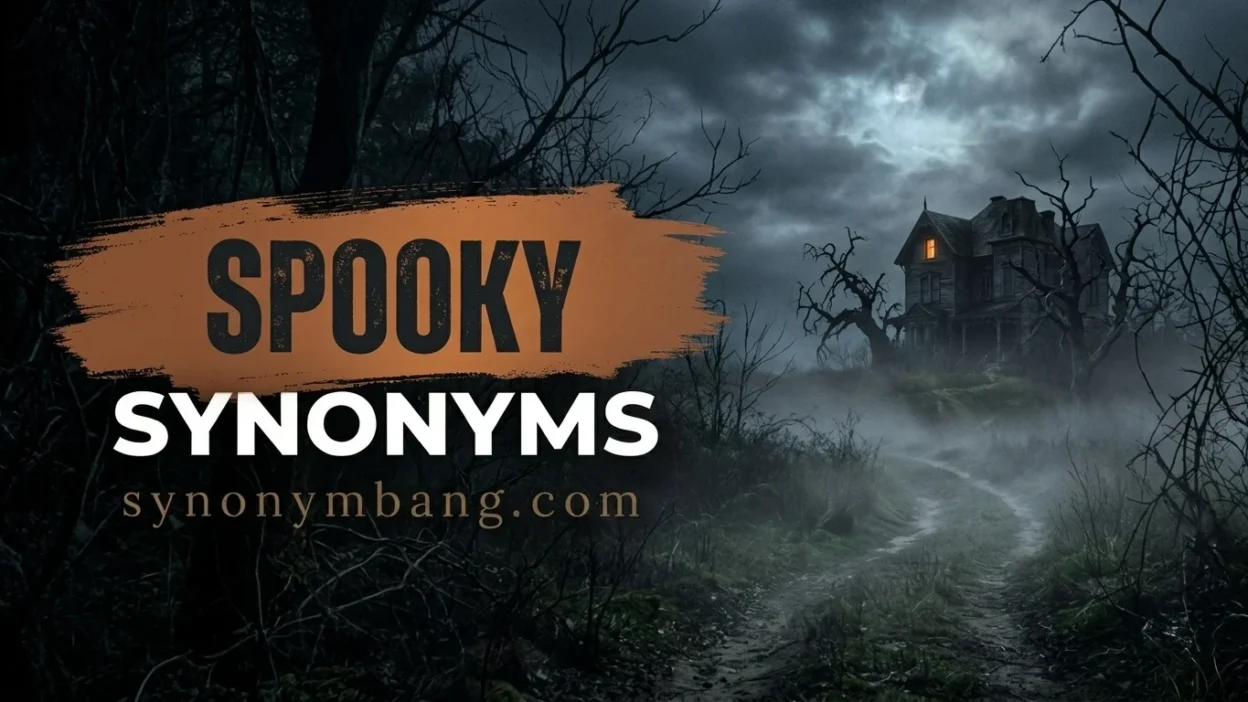
Spooky synonyms help you describe things that feel scary, mysterious, strange, or connected to the supernatural. Whether you are writing a Halloween story, describing a haunted house, creating suspense, or improving your vocabulary, choosing the right word can make your writing more vivid and interesting.
The word spooky is commonly used for places, sounds, situations, and experiences that create a feeling of fear or uneasiness. However, not every spooky experience feels the same. A dark forest may seem eerie, a ghost story may feel haunting, and a sudden noise in an empty house may sound creepy.
Learning different spooky synonyms allows you to express these feelings more precisely. In this guide, you will discover 30 useful alternatives, their simple meanings, example sentences, and the best situations in which to use them.
What Does Spooky Mean?
Spooky is an adjective that describes something strange, frightening, mysterious, or seemingly supernatural. It often creates a feeling that something unusual or frightening might happen.
The word is informal and commonly appears in everyday conversations, fiction, movies, and Halloween-related content. It can describe anything from a creepy old building to an unexplained sound in the middle of the night.
Examples:
- The abandoned house looked spooky after sunset.
- We heard a spooky noise coming from the basement.
- The movie had a spooky atmosphere that kept everyone alert.
The tone of spooky can range from playful to genuinely frightening. A spooky costume may be fun, while a spooky experience in an isolated place may feel unsettling.
30 Spooky Synonyms With Meanings and Examples
Here are 30 spooky synonyms that can help you describe fear, mystery, darkness, and supernatural experiences.
1. Eerie
Meaning: Strange and frightening in a mysterious way.
Example: An eerie silence filled the empty hallway.
Best usage: Use it to describe unusual places, sounds, or situations that create a feeling of mystery.
2. Creepy
Meaning: Causing an uncomfortable or frightened feeling.
Example: The creepy doll seemed to stare at everyone in the room.
Best usage: Ideal for unsettling people, objects, stories, and places.
3. Scary
Meaning: Causing fear or making someone feel frightened.
Example: The scary movie made us jump out of our seats.
Best usage: Use it as a simple, everyday alternative to spooky.
4. Frightening
Meaning: Making someone feel afraid.
Example: The frightening sound came from somewhere outside the house.
Best usage: Suitable for serious situations, dangerous events, and intense experiences.
5. Haunting
Meaning: Beautiful, disturbing, or frightening in a way that stays in your memory.
Example: A haunting melody played throughout the mysterious film.
Best usage: Use it for memories, music, images, stories, and places that leave a lasting emotional impression.
6. Sinister
Meaning: Suggesting that something evil or harmful may happen.
Example: The stranger gave the detective a sinister smile.
Best usage: Best for villains, suspicious behavior, and threatening situations.
7. Ghostly
Meaning: Resembling a ghost or appearing pale and supernatural.
Example: A ghostly figure appeared behind the fog.
Best usage: Use it when describing ghosts, shadows, pale figures, or supernatural appearances.
8. Chilling
Meaning: Causing intense fear or making someone feel deeply unsettled.
Example: The witness shared a chilling account of the strange event.
Best usage: Ideal for disturbing stories, revelations, and frightening experiences.
9. Ominous
Meaning: Suggesting that something bad may happen soon.
Example: Ominous clouds gathered above the abandoned cemetery.
Best usage: Use it to build suspense or foreshadow danger in a story.
10. Unsettling
Meaning: Making someone feel nervous, uncomfortable, or uncertain.
Example: There was something unsettling about the empty playground at midnight.
Best usage: Best for situations that create discomfort without necessarily causing strong fear.
11. Spine-Chilling
Meaning: Extremely frightening or disturbing.
Example: We heard a spine-chilling scream from the forest.
Best usage: Use it for horror stories, terrifying sounds, and intense moments of suspense.
12. Macabre
Meaning: Connected with death, dead bodies, or disturbing details.
Example: The artist created a macabre painting filled with skulls.
Best usage: Suitable for dark art, gothic fiction, and disturbing descriptions involving death.
13. Supernatural
Meaning: Seemingly beyond the laws of nature, such as ghosts or magical forces.
Example: The villagers believed a supernatural force haunted the building.
Best usage: Use it when discussing ghosts, spirits, unexplained powers, or paranormal events.
14. Mysterious
Meaning: Difficult to understand or explain.
Example: A mysterious light appeared above the lake every evening.
Best usage: Ideal when something feels strange or unexplained, even if it is not directly frightening.
15. Sinister-Looking
Meaning: Having an appearance that suggests evil or danger.
Example: The sinister-looking mansion stood at the end of the road.
Best usage: Use it to describe threatening buildings, faces, objects, or characters.
16. Hair-Raising
Meaning: Extremely frightening or exciting in a way that causes a strong physical reaction.
Example: The hikers told us a hair-raising story about their night in the mountains.
Best usage: Great for dramatic stories and thrilling experiences.
17. Uncanny
Meaning: Strange in a way that feels unnatural or difficult to explain.
Example: The statue had an uncanny resemblance to the missing man.
Best usage: Use it for unusual similarities, strange behavior, or experiences that feel almost unreal.
18. Foreboding
Meaning: Creating a strong feeling that something bad is about to happen.
Example: A sense of foreboding spread through the house.
Best usage: Excellent for suspenseful writing and scenes that suggest approaching danger.
19. Dark
Meaning: Having little light or suggesting sadness, danger, or evil.
Example: The story explored the dark secrets of an abandoned village.
Best usage: Use it for gloomy settings, disturbing themes, and frightening atmospheres.
20. Ghoulish
Meaning: Morbid, gruesome, or resembling a ghoul.
Example: The children wore ghoulish masks for Halloween.
Best usage: Best for Halloween decorations, monsters, and frightening or grotesque appearances.
21. Petrifying
Meaning: So frightening that it makes someone feel unable to move.
Example: The thought of being trapped underground was petrifying.
Best usage: Use it for extreme fear or terrifying situations.
22. Terrifying
Meaning: Causing very strong fear.
Example: The terrifying storm shook the windows all night.
Best usage: Ideal for intense danger, horror scenes, and overwhelming fear.
23. Frigid
Meaning: Extremely cold; sometimes used figuratively for a cold or unfriendly atmosphere.
Example: A frigid wind blew through the deserted graveyard.
Best usage: Use it when cold temperatures contribute to an eerie setting. It is not a direct synonym for spooky in every context.
24. Weird
Meaning: Unusual, strange, or unexpected.
Example: We noticed a weird shadow moving across the wall.
Best usage: A casual alternative for strange experiences that may also feel spooky.
25. Creepshow
Meaning: An informal term for something resembling a disturbing horror spectacle or grotesque display.
Example: The abandoned carnival looked like a real creepshow.
Best usage: Use it informally for exaggerated horror scenes or disturbing displays. It is not a direct adjective synonym for spooky.
26. Frightful
Meaning: Very unpleasant, alarming, or frightening.
Example: The travelers faced frightful conditions during the storm.
Best usage: Suitable for dramatic descriptions, dangerous situations, and traditional storytelling.
27. Shadowy
Meaning: Full of shadows or difficult to see clearly.
Example: A shadowy figure stood near the old gate.
Best usage: Use it for dimly lit places, unclear figures, and mysterious settings.
28. Spectral
Meaning: Resembling a ghost or spirit.
Example: A spectral glow appeared in the abandoned church.
Best usage: Best for poetic, literary, or supernatural descriptions.
29. Bloodcurdling
Meaning: So frightening that it seems to make the blood run cold.
Example: A bloodcurdling howl echoed across the empty fields.
Best usage: Use it for extremely frightening screams, cries, and horror scenes.
30. Dreadful
Meaning: Very unpleasant, frightening, or terrible.
Example: A dreadful feeling came over her as she entered the cellar.
Best usage: Suitable for serious descriptions of fear, danger, or distress.
Comparison Table: Choosing the Best Spooky Synonym
Different spooky synonyms communicate different levels and types of fear. Use this table to choose the word that best fits your sentence.
| Synonym | Main feeling | Best context |
| Eerie | Strange and mysterious | Quiet places and unusual sounds |
| Creepy | Uncomfortable fear | People, objects, and situations |
| Scary | General fear | Everyday conversations |
| Haunting | Lasting emotional effect | Music, memories, and images |
| Sinister | Evil or threatening | Villains and suspicious behavior |
| Ghostly | Supernatural appearance | Ghosts, pale figures, and shadows |
| Chilling | Deep fear | Disturbing stories and revelations |
| Ominous | Approaching danger | Weather and suspenseful scenes |
| Unsettling | Uneasiness | Uncomfortable experiences |
| Macabre | Death-related horror | Gothic art and dark fiction |
| Uncanny | Unnatural strangeness | Unexplained similarities |
| Foreboding | Expectation of trouble | Suspense and foreshadowing |
| Terrifying | Extreme fear | Dangerous or horrifying events |
| Shadowy | Darkness and uncertainty | Dimly lit settings |
| Spectral | Ghostlike quality | Literary supernatural scenes |
| Bloodcurdling | Intense terror | Screams and frightening sounds |
Spooky Synonyms for Different Situations
For Haunted Houses and Dark Places
Choose eerie, creepy, shadowy, ghostly, or haunting.
Example: The eerie mansion stood beneath the shadowy trees.
These words create a mysterious atmosphere without requiring a direct description of danger.
For Horror Stories and Movies
Choose terrifying, chilling, spine-chilling, bloodcurdling, or petrifying.
Example: The director created a chilling scene that audiences remembered for years.
These terms communicate stronger fear and work well in horror-related content.
For Mysterious Events
Choose uncanny, mysterious, supernatural, spectral, or weird.
Example: An uncanny sound came from the empty room.
These words are useful when the cause of an event is unknown or seems impossible to explain.
For Evil Characters and Threatening Situations
Choose sinister, ominous, foreboding, or sinister-looking.
Example: The villain gave an ominous warning before leaving.
These alternatives create tension and suggest that something harmful may happen.
For Dark and Disturbing Themes
Choose macabre, ghoulish, dreadful, or frightful.
Example: The writer used macabre imagery to make the story more disturbing.
These words work especially well in gothic fiction, Halloween descriptions, and horror writing.
How to Choose the Right Spooky Synonym
Selecting the right synonym depends on what you want readers to feel. Although many spooky synonyms are related to fear, they are not interchangeable in every situation.
1. For simple, everyday English
Use scary, creepy, or weird. These words are easy to understand and work well in casual conversations.
Example: That was a creepy noise.
2. For mystery and atmosphere
Use eerie, uncanny, or shadowy. These words make a scene feel strange or unexplained.
Example: An eerie mist covered the empty road.
3. For serious danger
Use sinister, ominous, or foreboding. These terms suggest evil intentions or trouble ahead.
Example: An ominous silence fell over the room.
4. For intense fear
Use terrifying, petrifying, or bloodcurdling. These words express stronger emotional reactions.
Example: The bloodcurdling scream frightened everyone.
5. For supernatural descriptions
Use ghostly, spectral, or supernatural. These words are particularly useful for ghost stories and paranormal themes.
Example: A spectral figure appeared near the window.
6. For literary or emotional effects
Use haunting, chilling, or macabre. These words can add depth, atmosphere, and emotional intensity to creative writing.
Example: The haunting melody made the scene unforgettable.
Common Mistakes When Using Spooky Synonyms
Even though these words share similar meanings, using them correctly improves your writing.
- Using eerie and terrifying interchangeably: Eerie describes strange, mysterious discomfort, while terrifying suggests intense fear.
- Using sinister for every strange object: Sinister implies a suggestion of evil or harmful intent, not simply something unusual.
- Using supernatural without context: This word refers to phenomena beyond ordinary natural explanations, rather than anything merely frightening.
- Using macabre for ordinary scary situations: Macabre is more specifically associated with death and disturbing imagery.
- Overusing spooky: Repeating the same word can make descriptions feel predictable. Vary your vocabulary to make your writing more engaging.
The best synonym is the one that communicates your intended meaning clearly and naturally.
Frequently Asked Questions
1. What is the closest synonym for spooky?
Creepy and eerie are two of the closest synonyms. Creepy emphasizes discomfort or fear, while eerie emphasizes mystery and strangeness.
2. What is a stronger word for spooky?
Terrifying, spine-chilling, and bloodcurdling express stronger fear than spooky.
3. What is a fancy word for spooky?
Eerie, uncanny, spectral, and macabre are useful alternatives for more descriptive or literary writing.
4. What is a synonym for spooky but not scary?
Mysterious, uncanny, and strange can describe unusual or unexplained things without necessarily suggesting intense fear.
5. What are some spooky words for Halloween?
Popular choices include creepy, ghostly, ghoulish, eerie, sinister, and haunting. They work well for Halloween stories, decorations, costumes, and party descriptions.
6. What is the difference between spooky and creepy?
Spooky often suggests ghosts, mystery, or supernatural events. Creepy usually describes something that makes a person feel uncomfortable, nervous, or disturbed.
7. Can spooky synonyms be used in academic writing?
Yes, when appropriate. Words such as ominous, unsettling, uncanny, and haunting can improve descriptive writing, although formal academic writing should prioritize precision and context.
Conclusion
Spooky synonyms help you describe frightening, mysterious, and supernatural experiences with greater accuracy. Words such as creepy, eerie, and ghostly are useful for everyday descriptions, while ominous, sinister, and foreboding build suspense. Stronger alternatives such as terrifying, petrifying, and bloodcurdling communicate intense fear.
The key is to match each word to the feeling you want to express. By understanding the differences between these 30 alternatives, you can create more engaging stories, improve your vocabulary, and make your descriptions more vivid. if you are writing a Halloween article, a horror story, or a simple sentence, the right spooky synonym can make all the difference.

Hi, I’m Nathan Cooper, a language enthusiast passionate about synonyms and vocabulary. I create clear, accurate, and engaging content that helps readers expand their word knowledge and communicate with confidence every day.