
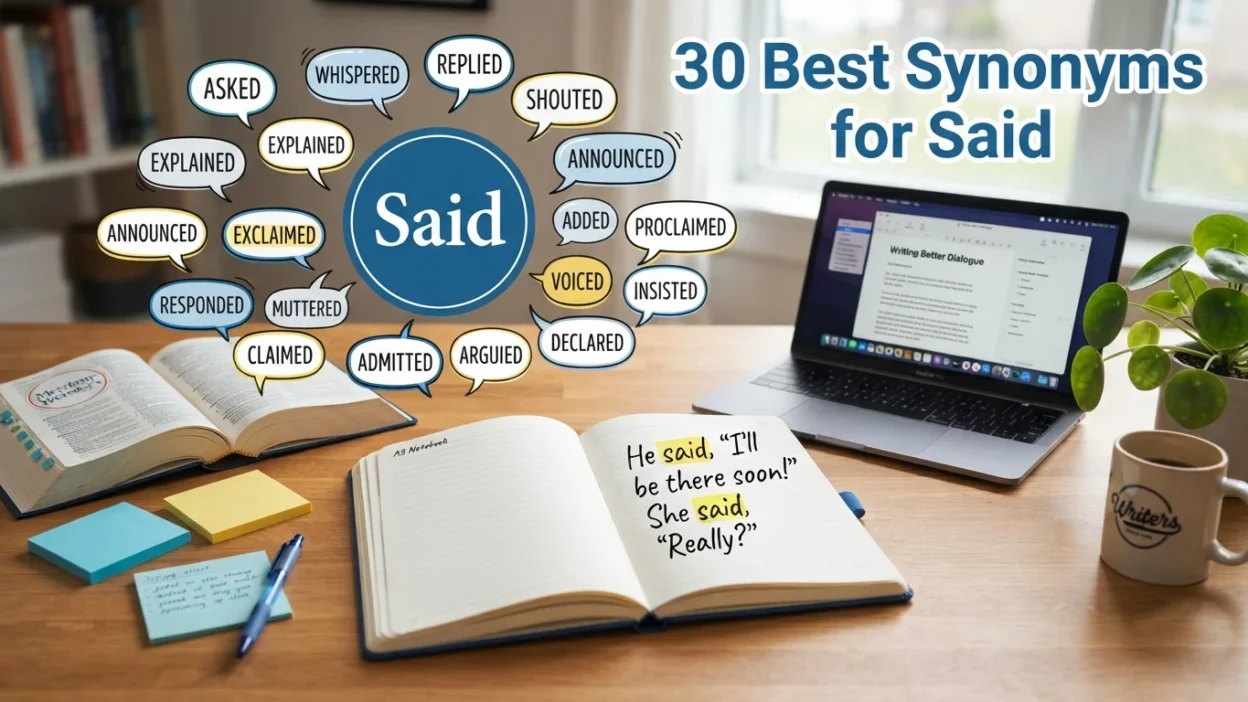
Choosing the right synonyms for said can make your writing more expressive, natural, and enjoyable to read. Whether you are writing a story, essay, blog post, or dialogue, using different words instead of repeating “said” helps reveal emotions, tone, and personality. Students, ESL learners, writers, and content creators often search for better alternatives to improve vocabulary and create stronger sentences.
In everyday writing, “said” is a perfectly correct verb, but using a variety of speech verbs can make conversations feel more realistic. Some words express excitement, while others show sadness, anger, surprise, or confidence. Learning these subtle differences helps you communicate more clearly and effectively. This guide explains each synonym in simple English, provides easy examples, and shows when each word works best.
What Does “Said” Mean?
The word said is the past tense of say, which means to speak or express something using words. It is the most common reporting verb in English because it is neutral and works in almost every conversation.
Example:
“I’ll help you tomorrow,” Sarah said.
Although “said” is useful, repeating it too often can make writing feel repetitive. That’s why many writers use synonyms to better match the speaker’s emotion or intention.
Synonyms for Said
1. Asked
Meaning: To request information or a response.
Example: “Can you help me?” Tom asked.
Best Usage: Questions and polite requests.
2. Replied
Meaning: To answer someone.
Example: “Yes, I can,” she replied.
Best Usage: Responding to another speaker.
3. Answered
Meaning: To give a response to a question.
Example: Maria answered quickly.
Best Usage: Formal or everyday conversations.
4. Whispered
Meaning: To speak very quietly.
Example: “Be careful,” he whispered.
Best Usage: Secrets or quiet moments.
5. Shouted
Meaning: To speak very loudly.
Example: “Watch out!” she shouted.
Best Usage: Emergencies or excitement.
6. Yelled
Meaning: To speak loudly with strong emotion.
Example: Dad yelled from the kitchen.
Best Usage: Anger or calling someone.
7. Murmured
Meaning: To speak softly and unclearly.
Example: He murmured an apology.
Best Usage: Shyness or uncertainty.
8. Mumbled
Meaning: To speak unclearly.
Example: She mumbled under her breath.
Best Usage: Nervous or embarrassed speech.
9. Explained
Meaning: To make something easier to understand.
Example: The teacher explained the lesson.
Best Usage: Giving information.
10. Added
Meaning: To include more information.
Example: “Don’t forget your notebook,” she added.
Best Usage: Continuing a conversation.
11. Commented
Meaning: To express an opinion.
Example: He commented on the weather.
Best Usage: Casual observations.
12. Mentioned
Meaning: To refer to something briefly.
Example: Anna mentioned the meeting.
Best Usage: Casual conversations.
13. Stated
Meaning: To express something clearly and formally.
Example: The manager stated the new policy.
Best Usage: Business or academic writing.
14. Declared
Meaning: To announce confidently.
Example: She declared victory.
Best Usage: Formal or dramatic situations.
15. Announced
Meaning: To make something known publicly.
Example: The principal announced the results.
Best Usage: Public information.
16. Claimed
Meaning: To say something is true.
Example: He claimed he saw the accident.
Best Usage: Statements that may need proof.
17. Suggested
Meaning: To offer an idea.
Example: She suggested going earlier.
Best Usage: Advice or recommendations.
18. Admitted
Meaning: To confess something.
Example: He admitted his mistake.
Best Usage: Honest confessions.
19. Confessed
Meaning: To admit something personal or secret.
Example: She confessed the truth.
Best Usage: Emotional situations.
20. Promised
Meaning: To give your word.
Example: He promised to return.
Best Usage: Commitments.
21. Agreed
Meaning: To have the same opinion.
Example: They agreed immediately.
Best Usage: Discussions and teamwork.
22. Insisted
Meaning: To say something firmly.
Example: She insisted on paying.
Best Usage: Strong opinions.
23. Argued
Meaning: To express disagreement.
Example: They argued about the plan.
Best Usage: Debates or conflicts.
24. Exclaimed
Meaning: To speak suddenly with emotion.
Example: “That’s amazing!” he exclaimed.
Best Usage: Surprise or excitement.
25. Remarked
Meaning: To make a brief comment.
Example: She remarked that it looked nice.
Best Usage: General observations.
26. Observed
Meaning: To notice and comment.
Example: The scientist observed the changes.
Best Usage: Careful observations.
27. Noted
Meaning: To point out something important.
Example: The guide noted the difference.
Best Usage: Academic or professional writing.
28. Laughed
Meaning: To speak while laughing.
Example: “That’s funny,” she laughed.
Best Usage: Happy conversations.
29. Cried
Meaning: To speak while upset or loudly.
Example: “Please wait!” he cried.
Best Usage: Emotional scenes.
30. Responded
Meaning: To react with words.
Example: She responded politely.
Best Usage: Formal and informal replies.
Synonyms for Said Comparison Guide
| Synonym | Emotion | Best For | Formality |
|---|---|---|---|
| Said | Neutral | Everyday dialogue | Neutral |
| Asked | Curious | Questions | Neutral |
| Replied | Neutral | Responses | Neutral |
| Whispered | Quiet | Secrets | Neutral |
| Shouted | Loud | Warnings | Neutral |
| Explained | Helpful | Teaching | Formal |
| Stated | Serious | Reports | Formal |
| Declared | Confident | Announcements | Formal |
| Suggested | Friendly | Advice | Neutral |
| Admitted | Honest | Confessions | Neutral |
| Insisted | Firm | Strong opinions | Neutral |
| Exclaimed | Excited | Surprise | Neutral |
| Responded | Neutral | Replies | Formal/Neutral |
How to Choose the Right Synonym
Selecting the best synonym depends on the speaker’s emotion and the situation.
For Neutral Conversations
Use said, replied, answered, responded, or added when the emotion is not important.
For Questions
Choose asked whenever someone wants information.
For Quiet Speech
Use whispered, murmured, or mumbled for soft or unclear voices.
For Loud or Emotional Speech
Pick shouted, yelled, exclaimed, or cried when strong emotions are involved.
For Formal Writing
Words like stated, declared, announced, noted, and observed fit reports, articles, and academic writing.
For Opinions and Ideas
Use commented, remarked, mentioned, or suggested to share thoughts naturally.
For Honesty and Confession
Choose admitted or confessed when someone accepts responsibility or reveals something personal.
Common Tips for Using Synonyms for Said
- Match the word with the speaker’s emotion.
- Don’t replace every “said.” Sometimes it is still the best choice.
- Avoid using dramatic words when the conversation is ordinary.
- Read your dialogue aloud to check whether it sounds natural.
- Build your vocabulary by learning the subtle differences between similar words.
Frequently Asked Questions
Is it bad to use “said” repeatedly?
No. Professional writers still use “said” often because readers usually don’t notice it. However, adding suitable synonyms can make important dialogue more expressive.
Which synonym is best for formal writing?
Words like stated, explained, noted, and responded are excellent choices in formal writing.
Which synonym shows strong emotion?
Shouted, yelled, exclaimed, cried, and insisted clearly show emotional intensity.
Are all synonyms interchangeable?
No. Every synonym carries a different tone and should match the situation.
How can ESL learners improve their vocabulary?
Practice reading stories, learn words in context, and write your own example sentences using different synonyms for “said.”
Conclusion
Learning different synonyms for said helps you create clearer, more engaging, and more natural writing. Instead of repeating the same reporting verb, you can choose words that express emotion, confidence, curiosity, excitement, or honesty. This makes stories, essays, and conversations more enjoyable for readers.
The key is to use each synonym naturally and only when it matches the speaker’s tone. With the 30 alternatives and practical examples in this guide, you’ll be able to improve your vocabulary, strengthen your writing skills, and communicate with greater confidence in every situation.

I am Alexander Reed, a language enthusiast passionate about synonyms and clear communication. I create accurate, easy-to-understand content that helps readers expand vocabulary, improve writing skills, and express ideas confidently every day.