
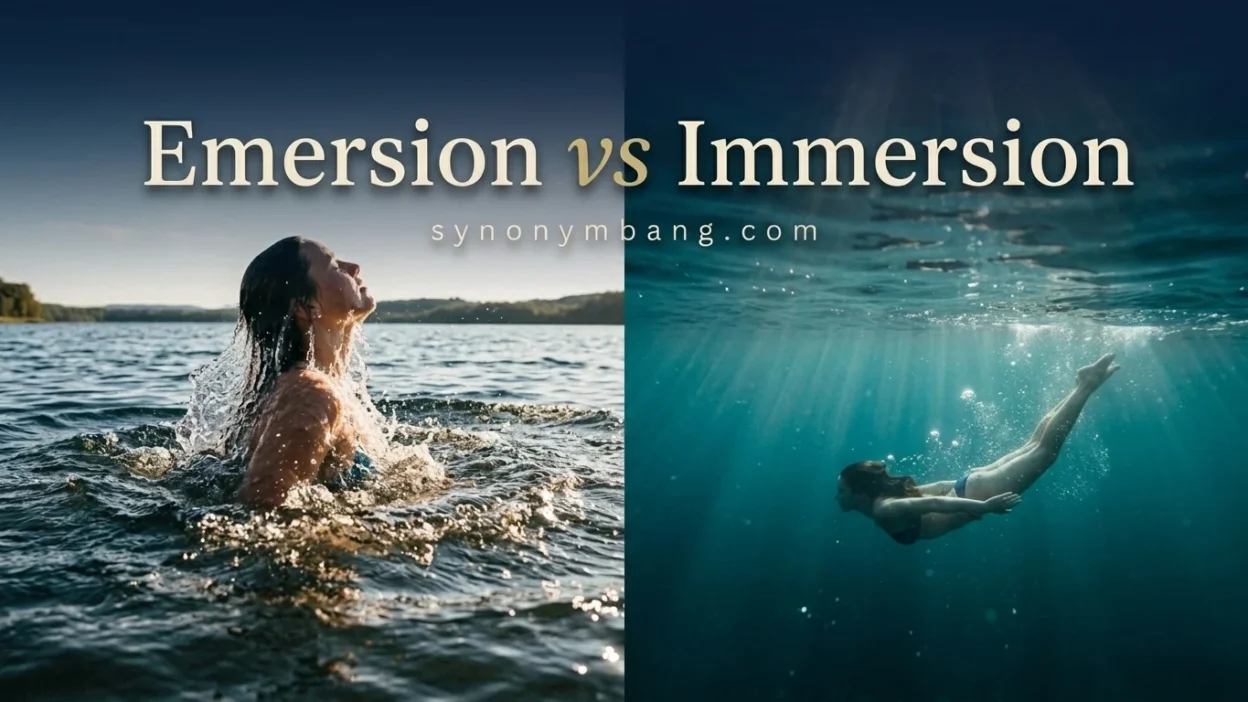
English is full of confusing words that look almost identical but have different meanings. Emersion vs immersion is a good example. Although these words share similar spelling, they describe different actions: one refers to emerging from something, while the other refers to entering something or becoming deeply involved in an experience.
Imagine a scuba diver exploring beneath the ocean’s surface. The diver’s time underwater involves immersion, while the process of coming back to the surface can be described as emersion. This simple example makes the difference easier to understand.
Both words appear in scientific discussions, but immersion is much more common in everyday English. You will encounter it in language immersion, cultural immersion, education, psychology, and technology. Emersion is less common and is especially useful in scientific contexts, such as describing a celestial body reappearing after being obscured. Understanding their meanings, examples, and correct usage will help you choose the right word and avoid common writing mistakes.
Quick Answer: Emersion vs Immersion
Emersion means emerging from a liquid or reappearing after being hidden or obscured. Immersion means placing something into a liquid or becoming deeply involved in an activity, language, or culture. Remember emersion = coming out and immersion = going in or becoming absorbed. The words are not interchangeable.
Why Do People Confuse Emersion and Immersion?
People often confuse emersion and immersion because the words differ by only a few letters and both can relate to being underwater. However, their meanings point in different directions.
- Emersion: Emerging from a liquid or becoming visible again.
- Immersion: Entering a liquid or becoming deeply involved in something.
The confusion also comes from how frequently immersion appears in everyday English. Expressions such as immersion learning, immersive experiences, and cultural immersion are common. In contrast, emersion is relatively rare and tends to appear in specialized scientific or technical writing.
For example, placing an object into water is immersion. Describing its emergence from the water is emersion. The surrounding context tells you which word is correct.
What Does Emersion Mean?

Emersion is a noun meaning the act or process of emerging from a liquid or reappearing after being hidden, covered, or obscured.
It is related to the verb emerge, which means to come out, appear, or become visible.
Emersion in Science and Astronomy
Emersion is especially useful in scientific contexts where the precise moment something reappears matters.
1. Marine biology
In coastal environments, marine organisms may alternate between immersion in seawater and emersion when the tide recedes.
Example: The researchers studied how intertidal organisms survived periods of emersion during low tide.
2. Astronomy
In astronomy, emersion can describe a celestial body reappearing after being hidden behind another object during an occultation or similar event.
Example: The astronomer recorded the star’s emersion after it reappeared from behind the Moon.
3. Environmental science
Scientists may study emersion when examining how changing water levels expose coastal habitats to air, sunlight, and temperature fluctuations.
Example: The research team observed the emersion of marine organisms as the tide moved out.
Everyday Examples of Emersion
- The diver’s emersion marked the end of the underwater experiment.
- The submerged instrument’s emersion was carefully recorded.
- The island’s gradual emersion became visible as the water level fell.
- The celestial body’s emersion was observed through a telescope.
In ordinary conversation, words such as emerging, coming out, and reappearing may sound more natural. However, emersion is appropriate when you specifically mean the process of emerging from a submerged or obscured state.
What Does Immersion Mean?
Immersion is a noun with two main meanings: placing something into a liquid and becoming deeply involved in an activity, environment, or experience.
It comes from the verb immerse, which means to put something into a substance or involve someone deeply in something.
1. Physical Immersion
Physical immersion occurs when an object or person is placed in a liquid.
Examples include:
- Immersion of a thermometer in water.
- Immersion of fabric in dye.
- Immersion of equipment during a controlled scientific test.
- Immersion in water during certain baptism ceremonies.
Example sentence: The technician tested the material through immersion in water.
2. Immersion in Education and Language Learning
Language immersion is a learning approach in which students receive extensive exposure to a language through lessons, conversations, and everyday activities.
For example, a student learning Spanish might attend Spanish-language classes, speak with native speakers, and watch Spanish-language programs.
Example sentence: The school introduced a French immersion program to help students develop practical communication skills.
Immersion can support language learning by giving students regular opportunities to listen, speak, read, and write in the target language. Progress still depends on factors such as practice, instruction, and individual learning needs.
3. Immersion in Psychology
In psychology and related fields, immersion can describe becoming deeply absorbed in an activity or experience.
Examples include:
- Reading a novel so engaging that you lose track of time.
- Concentrating fully on a challenging task.
- Becoming emotionally involved in a film.
- Experiencing a strong sense of presence in a virtual environment.
Example sentence: The player experienced deep immersion while exploring the game’s fictional world.
Immersion is related to intense engagement, but it is not automatically the same as the psychological concept of flow, which involves a particular state of focused activity.
4. Immersion in Technology and Gaming
Modern technology often aims to create immersive experiences that make users feel involved in a digital environment.
Virtual reality, interactive simulations, and video games can create immersion through realistic visuals, spatial audio, responsive controls, and interactive storytelling.
Example sentence: The virtual reality headset provided an immersive experience that made the training simulation feel realistic.
5. Immersion in Culture and Travel
Cultural immersion means experiencing another culture through direct participation in its everyday life, customs, and traditions.
Common examples include:
- Living with a host family.
- Learning a local language.
- Attending cultural festivals.
- Trying traditional cooking.
- Participating in community activities.
Example sentence: Cultural immersion helped the travelers understand local customs beyond what they had read in books.
Emersion vs Immersion: Key Differences
| Feature | Emersion | Immersion |
| Part of speech | Noun | Noun |
| Main meaning | Emerging or reappearing | Entering or becoming deeply involved |
| Direction | Outward, from a submerged state | Into something or deeply within an experience |
| Physical use | Emerging from water | Being placed into water |
| Figurative use | Limited and context-dependent | Common in learning, culture, and entertainment |
| Scientific use | Marine science and astronomy | Laboratory experiments and other sciences |
| Everyday frequency | Relatively rare | Very common |
| Related verb | Emerge | Immerse |
| Example | The star’s emersion was observed. | The student joined a language immersion program. |
The simplest distinction is emersion = emerging and immersion = entering or becoming absorbed.
When Should You Use Emersion vs Immersion?
Choosing between the words becomes easier when you identify what is happening in your sentence.
Use Emersion When Something Comes Out
Choose emersion when describing something emerging from water or reappearing after being obscured.
Examples:
- The instrument’s emersion from the tank was recorded.
- Scientists observed the emersion of the star after the occultation.
- The researchers documented periods of emersion during low tide.
In everyday writing, emergence or reappearance may be more suitable when you are not describing a specific scientific event.
Use Immersion When Something Goes In
Choose immersion when an object is placed in a liquid or becomes submerged.
Examples:
- The immersion of the fabric in dye changed its color.
- The scientist measured the effects of immersion on the material.
- The equipment was tested through controlled immersion.
Use Immersion for Learning and Experiences
Choose immersion when someone becomes deeply involved in a language, activity, culture, or digital environment.
Examples:
- Language immersion helped the students practice English.
- The travelers enjoyed immersion in local culture.
- The interactive exhibition offered an immersive experience.
- The course encouraged immersion in the subject through practical activities.
Do not use emersion to describe language learning or deep involvement. In these contexts, immersion is the standard word.
12 Emersion vs Immersion Examples in Sentences
These examples show how the words work in different situations.
Examples of Emersion
- The diver’s emersion from the water marked the end of the experiment.
- The researchers recorded the emersion of the instrument after lifting it from the tank.
- The island’s gradual emersion became visible as the water level decreased.
- The astronomer observed the star’s emersion after it reappeared from behind the Moon.
- Marine organisms must tolerate periods of emersion when the tide recedes.
- The scientist documented the emersion of the submerged object.
Examples of Immersion
- The school offers a Spanish language immersion program.
- The technician tested the material through immersion in water.
- The students experienced cultural immersion during their stay abroad.
- The virtual reality headset created an immersive gaming experience.
- The artist used immersion in colored dye to transform the fabric.
- The student improved her conversational skills through immersion in an English-speaking environment.
Notice the contrast: emersion describes coming out or reappearing, while immersion describes entering, submerging, or becoming deeply involved.
Common Mistakes When Using Emersion and Immersion
Mistake 1: Using Emersion for Language Learning
Incorrect: Emersion in French helped her improve her speaking skills.
Correct: Immersion in French helped her improve her speaking skills.
Why? Language learning involves regular exposure and active participation, making immersion the correct choice.
Mistake 2: Using Emersion for Placing an Object in Water
Incorrect: The emersion of the device into the tank began the experiment.
Correct: The immersion of the device into the tank began the experiment.
Why? The device is being placed into the tank, so immersion is correct.
Mistake 3: Assuming Both Words Are Interchangeable
Although the words look similar, they describe different actions.
- Emersion: Coming out or reappearing.
- Immersion: Going in or becoming deeply involved.
Always check the direction or nature of the action before choosing a word.
Mistake 4: Confusing Emersion With Emergence
Emersion generally refers to emerging from a liquid or reappearing after being obscured. Emergence is broader and can refer to the appearance, development, or arrival of something.
Correct: The emergence of a new technology changed the industry.
Less natural: The emersion of a new technology changed the industry.
Use emergence when discussing new ideas, trends, technologies, or developments.
Mistake 5: Confusing Immersion With Submersion
Both words can refer to placing something beneath a liquid, but their meanings are not identical.
Immersion can describe entering a liquid or becoming deeply involved in an experience. Submersion emphasizes being placed beneath or covered by a liquid.
Example: The device was designed to withstand complete submersion in water.
Memory Trick: How to Remember Emersion vs Immersion
Use these two simple associations:
Emersion = Exit.
Think of the letter E as a reminder that something is exiting the water or coming out of a hidden state.
Immersion = Into.
Think of the letter I as a reminder that something is going into water or becoming deeply involved in an experience.
For example:
- A diver’s immersion begins when the diver enters the water.
- The diver’s emersion occurs when the diver comes back out.
For education and culture, remember that language immersion means learning through regular exposure and participation.
Emersion vs Immersion in American and British English
The meanings of emersion and immersion are essentially the same in American and British English. There is no standard regional spelling distinction between these words.
| Word | American English | British English |
| Emersion | Emerging from a liquid or reappearing | Emerging from a liquid or reappearing |
| Immersion | Entering a liquid or becoming deeply involved | Entering a liquid or becoming deeply involved |
| Language immersion | Learning through extensive exposure | Learning through extensive exposure |
For either audience, choose the word according to its meaning rather than the region where your readers live.
Similar Words: Emersion, Immersion, Emergence, and Submersion
Several related words can make this distinction easier to understand.
Emersion vs Emergence
Emersion usually refers to emerging from a liquid or reappearing after being hidden. Emergence has a broader meaning that includes appearing, developing, or becoming known.
Example: The emergence of a new scientific theory changed the debate.
Immersion vs Submersion
Immersion describes placing something in a liquid or becoming deeply involved in an experience. Submersion specifically emphasizes being beneath or covered by a liquid.
Example: Complete submersion may damage electronic equipment that is not waterproof.
Immersion vs Immersive
Immersion is a noun describing the act or state of deep involvement. Immersive is an adjective describing an experience that creates a strong sense of involvement.
Example: The museum created an immersive exhibition using sound, light, and interactive displays.
Immerse vs Emerge
Immerse is a verb meaning to put something into a liquid or become deeply involved. Emerge is a verb meaning to come out, appear, or become visible.
Examples:
- Immerse the fabric in the dye.
- The fabric emerged from the dye with a brighter color.
Emersion vs Emergence in Astronomy
In astronomy, emersion can describe a celestial object reappearing after being obscured by another body. Emergence can also describe something coming into view more generally.
Use the more specific term when it accurately describes the astronomical event.
Final Verdict: Emersion or Immersion?
The correct choice depends on the action you want to describe.
- Choose emersion when something comes out of a liquid or reappears after being obscured.
- Choose immersion when something is placed into a liquid or a person becomes deeply involved in an activity, language, or culture.
For example, placing a scientific instrument into a tank involves immersion. Bringing it back out can be described as emersion. Similarly, students who learn Spanish through daily communication experience language immersion, not language emersion.
In most everyday situations involving education, travel, psychology, and technology, immersion is the word you are likely to need. Emersion is less common but useful in precise scientific contexts.
Frequently Asked Questions
1. What is the difference between emersion and immersion?
Emersion means emerging from a liquid or reappearing after being obscured. Immersion means entering a liquid or becoming deeply involved in an activity or experience.
2. Is emersion a real word?
Yes. Emersion is a valid English noun used particularly in scientific and technical contexts. It can describe emerging from a liquid or a celestial body reappearing after being hidden.
3. What does immersion mean in simple English?
Immersion means putting something into a liquid or becoming deeply involved in something. For example, learning English by speaking it every day is language immersion.
4. What is the difference between emersion and immersion in psychology?
In psychology-related contexts, immersion can describe becoming deeply absorbed in an activity or experience. Emersion does not have an established general meaning of a reflective psychological stage after an experience. Use terms such as reflection or post-experience reflection for that idea.
5. What is the difference between emersion and immersion in school learning?
Immersion is a recognized educational approach in which students learn through extensive exposure to a language or subject. Emersion is not the standard term for the stage when students leave that environment or reflect on their learning.
6. What is an immersion blender?
An immersion blender is a handheld kitchen appliance used to blend food directly in a pot, bowl, or container. Its blending end is placed into the mixture. The correct term is immersion blender, not emersion blender.
7. What is the difference between submersion and immersion?
Submersion emphasizes being placed beneath or covered by a liquid. Immersion can also refer to placing something in a liquid, but it has broader meanings involving deep participation in language learning, culture, and other experiences.
8. Which word is more common: emersion or immersion?
Immersion is much more common in everyday English because it appears in education, language learning, travel, technology, and entertainment. Emersion is relatively rare and is more often encountered in scientific or technical contexts.
Remember This
- Emersion: Emerging from water or reappearing after being obscured.
- Immersion: Entering a liquid or becoming deeply involved.
- Language immersion: Learning through regular exposure and participation.
- Cultural immersion: Experiencing a culture through direct participation.
- Submersion: Being placed beneath or covered by a liquid.
- Emergence: The appearance, development, or arrival of something.
The easiest memory trick is Emersion = Exit and Immersion = Into. If something is coming out, consider emersion. If something is going in or becoming deeply involved, choose immersion.
Conclusion
Understanding emersion vs immersion becomes much easier when you focus on the direction and meaning of each word. Emersion refers to emerging from a liquid or reappearing after being obscured, while immersion describes entering a liquid or becoming deeply involved in an activity, language, culture, or experience. Although the words look similar, they are not interchangeable.
When writing about education, language learning, cultural experiences, or technology, choose immersion. When describing something emerging from water or reappearing after being hidden, emersion may be the precise term. Remember the difference between exit and into, and you will be able to use both words more confidently.

Hello, I’m Isabella Collins, a language enthusiast passionate about helping readers discover accurate synonyms and enrich their vocabulary. I create clear, practical content that makes English writing easier, stronger, and more expressive.